
If you've scrolled through a sports feed lately, watched a hockey broadcast, or walked past a TTC ad column, you've probably seen a casino offer dressed up to look effortless. A big number, a friendly phrase, a tiny line of fine print at the bottom. Most of us tune it out. The trouble starts when we don't.
This isn't a piece about whether you should gamble. It's about something more practical: how to read what those ads, bonus banners, comparison pages, and "safe casino" badges are actually saying. The same skill you'd use to decode a phone plan or an Air Miles offer applies here, with a few extra twists.
Most online gambling marketing isn't lying. It's just leaving things out. Your job as a reader is to notice the gaps.
Why Online Casino Language Deserves a Second Look
Casino language sounds plain on the surface. Bonus. Free spins. Payout. Licensed. Each word carries a quiet asterisk most people don't realize they signed up to read.
The same pattern shows up across the wider digital economy. Concert tickets that grow by 30% at checkout. Subscription cancellations buried three menus deep. Streaming bundles that "include" services you already pay for. Casinos sit on the same spectrum, sometimes pretty far down it.
The Competition Bureau has written about this under the umbrella of digital design and informed consumer choices. Its work on drip pricing and online presentation is a useful reminder that the headline number on any digital offer rarely matches what you end up paying or receiving. Gambling promos aren't formally called drip pricing, but the reading habit transfers cleanly.
Three quick patterns to watch for:
- A big number with a small condition ("100% bonus*")
- A friendly word doing heavy lifting ("safe," "verified," "official")
- Urgency where none should exist ("limited time," "today only")
Spot any of those, and slow down before doing anything else.
What a Casino Comparison Page Can and Cannot Tell You
Comparison sites are everywhere in this category. Some are useful checklists. Others are essentially storefronts dressed up as reviews. The difference matters.
A canadian casino comparison resource can be a reasonable starting point for vocabulary, license notes, payout descriptions, and province-by-province differences. The trick is treating it as a glossary rather than a recommendation.
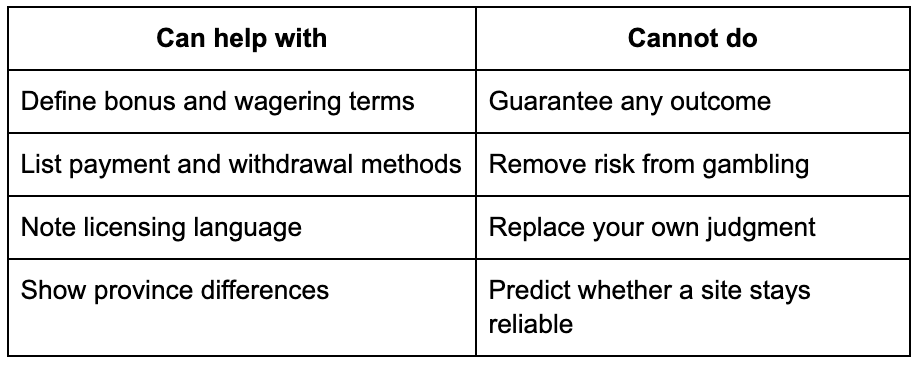
If a comparison page is doing its job, it teaches you what questions to ask. If it's nudging you toward one option with urgency and superlatives, that's marketing, not information.
What Is a Casino Bonus?
A casino bonus is a promotional offer attached to depositing or registering. It might come as matched funds, free spins, cashback, or credits applied to specific games. In every case, the headline number is the least important part of the story.
What matters more is everything written underneath:
- Eligibility (new accounts only, certain payment methods only)
- Expiry window
- Game restrictions (often slots only)
- Maximum bet while the bonus is active
- Maximum cashout
- Account verification requirements
A "$500 welcome bonus" with a 7-day expiry, 30x wagering, and a $100 max cashout is a very different offer from how it reads on the banner. Same number, completely different value.
What Is Casino Bonus Wagering?
Wagering, sometimes called rollover or playthrough, is the requirement to bet a certain multiple of the bonus (and sometimes the deposit) before any bonus-linked winnings can be withdrawn.
A round-number example for clarity:
A C$50 bonus with 30x wagering means you'd need to place C$1,500 in qualifying bets before withdrawal eligibility kicks in. Different games may count at different rates toward that total.
"Free" in this context doesn't mean immediately yours. It means yours after conditions are met, and those conditions can be substantial. Anyone telling you otherwise is selling rather than explaining.
What Is a No Wagering Casino?
"No wagering" usually means the rollover requirement on bonus winnings is removed or drastically reduced. It does not mean no conditions at all.
A short reality check before assuming "no wagering" equals "no strings":
- Minimum deposit may still apply
- Max bet rules can still be enforced
- Withdrawal caps often remain
- Certain payment methods may be excluded from bonus eligibility
- Verification still needs to be completed
- Game-specific restrictions may still limit how the bonus is used
No wagering is genuinely a friendlier structure than 35x rollover. It's just not a magic phrase.
What Is a Casino House Edge?
The house edge is the built-in mathematical advantage a casino holds over a game across many plays. It's expressed as a percentage and represents the average portion of every wager the house expects to keep over time.
A few generalities to keep the concept grounded:
- Different games carry different house edges
- Rule variations within one game can shift the edge meaningfully (single-zero versus double-zero roulette, for example)
- House edge describes long-run averages, not what happens in any single session
- A low house edge does not mean a player will profit
The reason this matters for marketing literacy is simple. When a site or influencer talks about "high payouts" or "great odds," the underlying math hasn't moved. The house edge is a structural feature of the game, not a promotional dial the operator can turn up for a weekend.
What Is a Casino Loyalty Program?
A loyalty program rewards repeated activity. Points accumulate, tiers unlock, and perks appear: cashback, faster withdrawals, personalized offers, branded merchandise, occasional event invitations. On paper, it's a thank-you. In practice, it's a retention system.
Two things can sit side by side here:
- Loyalty perks can be genuine value for someone already gambling within their limits.
- Those same perks are engineered to make stepping back feel like leaving something on the table.
Toronto runners know this feeling from the Strava streak. Coffee drinkers know it from Tim Hortons Roll Up The Rim. The mechanic is the same: a reward system that quietly nudges frequency upward. Worth recognizing for what it is.
Are Online Casinos Safe?
"Safe" is one of the most overworked words in this whole category. It hides a lot of variables behind a single syllable.
A more useful framing is to ask: safe for what, where, and according to whom? Safety in this context is jurisdiction-dependent. It's tied to licensing, payment protections, data handling, dispute resolution, responsible-gambling tools, and whether the operator is authorized in the player's province.
For Ontarians, the clearest reference point is iGaming Ontario's regulated market directory, which lists operators authorized to offer online gambling inside the province. The page notes that players must be 19+ and physically located in Ontario, and as of its most recent update it listed 44 operators and 77 gaming websites.
That directory is a stronger safety signal than any banner ad. It exists precisely because "safe" needed a definition.
Licensing, Location, and Regulated Markets
Canadian online gambling rules aren't national in the way many people assume. Each province handles it differently, and Ontario stands out for having a specific open, regulated online market launched in April 2022.
A licence line on a website is meaningful only when paired with location:
- Where is the player physically located?
- Where is the operator licensed?
- Is the licence valid for that jurisdiction?
Ontario's market isn't static, either. iGaming Ontario's market performance reporting is updated monthly, covering operators with gaming websites from market launch in April 2022 onward. Outside Ontario, the regulated picture differs by province, and what's legal access in one place may not be in another.
The practical takeaway: a licence claim is a starting point for verification, not an endorsement on its own.
Fraud Signals and Too-Good-To-Be-True Claims
Some red flags repeat themselves across gambling scams and adjacent fraud. They're worth memorizing because the patterns barely change year to year.
Common signals to slow down on:
- Guaranteed-win language or "system" pitches
- Pressure tactics ("expires in 10 minutes")
- Missing or vague licensing details
- Reviews that read like ad copy across multiple "independent" sites
- Celebrity endorsement claims you can't verify independently
- Pushy payment requests, especially in crypto or gift cards
- Refusal to clarify withdrawal terms in writing
- Customer service that only exists inside a chat app
If a gambling-related site or message sets off any of these, the Canadian Anti-Fraud Centre is the right next stop. The CAFC collects fraud and identity-theft information affecting Canadians and provides reporting channels. A sponsored review thread isn't a substitute.
A useful rule: if anyone is rushing you toward a deposit, the deposit is the goal, not your experience.
Responsible Gambling Is Part of the Reading Process
Responsible gambling isn't a footer disclaimer. It's part of how you read the marketing in the first place. The phrase loses meaning when it's tacked on as a closer; it gains meaning when it shapes what you do before clicking anything.
The Lower-Risk Gambling Guidelines translate "be careful" into actual numbers. For adults of legal gambling age who choose to gamble, the guidelines suggest:
- Keeping spend under 1% of monthly household income before tax
- Gambling on no more than 4 days per month
- Sticking to no more than 2 types of gambling regularly
Those aren't strategy tips. They're public-health thresholds developed specifically to reduce harm. They also work as a quick filter for any marketing pitch: if an offer is designed to push frequency, deposit size, or game variety above those lines, the offer isn't built around the player.
A short test before any deposit:
- Would this fit inside my monthly entertainment budget without rearrangement?
- Am I about to gamble more frequently than usual to chase this offer?
- Is the offer pulling me toward a game I don't normally play?
Two yeses is a pause. Three is a closed tab.
A Practical Checklist Before Trusting Any Casino Claim
Here's the whole article boiled down to the kind of list worth keeping on hand. None of it requires expertise. All of it requires slowing down for sixty seconds.
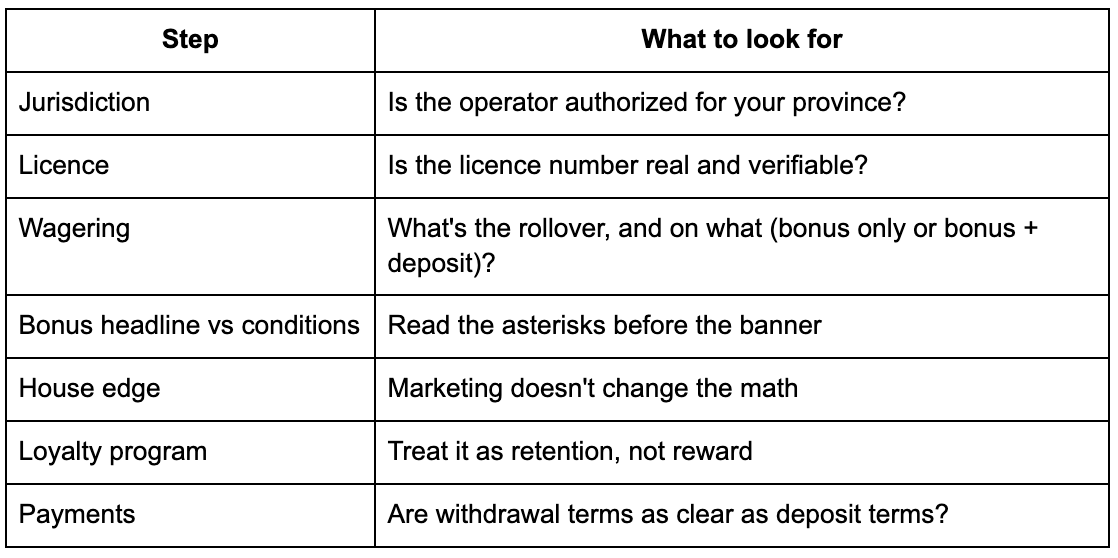

The same rule applies to any comparison page, any review, any influencer thread: use it to identify the questions you still need to answer, not to skip the answering.
If you came here hoping for a recommendation, this isn't that article and was never going to be. What's on offer instead is something more durable. The marketing will keep changing. The reading skill stays useful.