
Toronto is one of the most contested digital markets in Canada, with well over 300 agencies competing for a share of local search demand. In a market that crowded, ranking well on Google is no longer the finish line — it's the entry fee. Buyers now discover companies through AI-generated answers, YouTube, Reddit threads, and industry newsletters just as often as through a traditional results page, and each of those surfaces rewards a different mix of signals than classic SEO does. A company can hold a strong position for its core keywords and still be entirely absent from the summary an AI assistant gives the same buyer a moment later.
That shift is why more Toronto companies now build their search strategy around a broader foundation than backlinks and keyword pages. Many start by working with a provider of seo toronto services that treats technical rankings, AI-answer visibility, and content distribution as one coordinated program rather than separate line items added on later. The technical groundwork — site speed, crawlability, a clean content structure — still matters. It's simply no longer sufficient on its own.
Ways Toronto Companies Are Expanding Beyond Classic Rankings
- Auditing AI-answer visibility alongside technical SEO. Rather than treating AI-search work as an afterthought, agencies such as Panem now pair a standard technical SEO audit with a review of AI-answer visibility, so a company's Google rankings and its presence in ChatGPT, Gemini, and Perplexity answers get planned as one program instead of two.
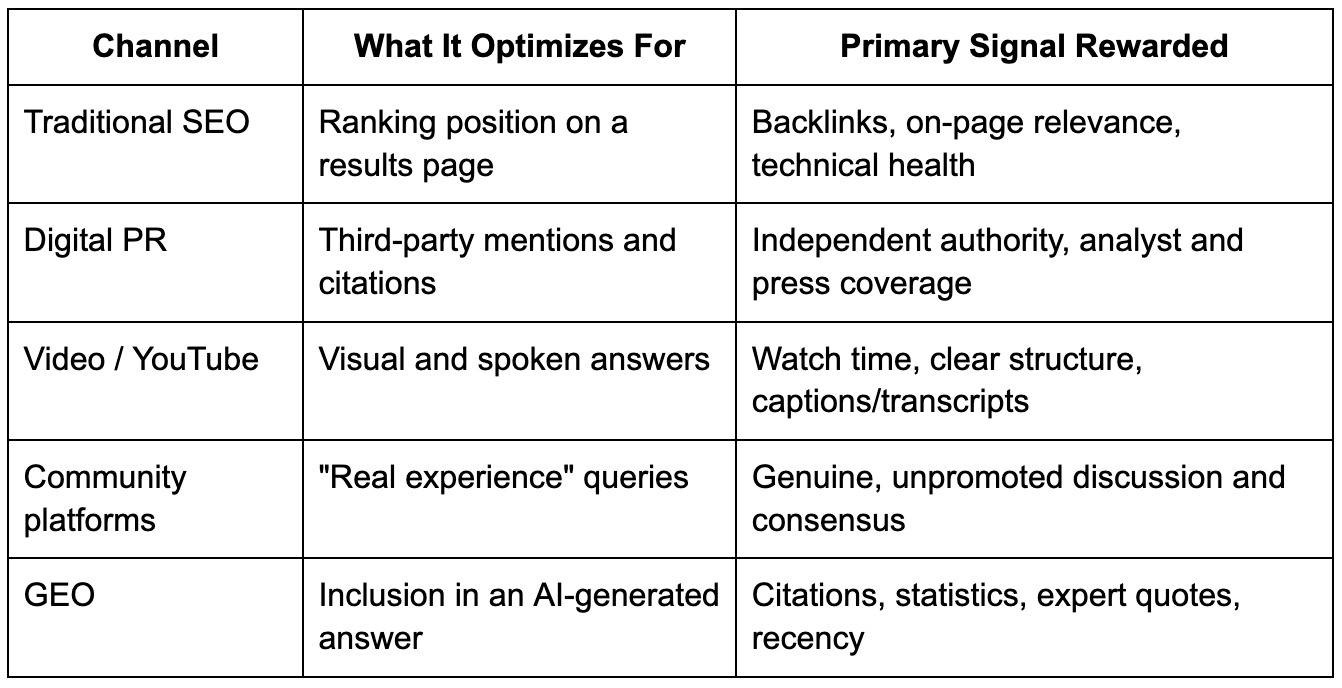
- Digital PR and earned media. AI systems weigh third-party citations, analyst mentions, and expert commentary heavily when deciding which brands to reference — arguably more than another paid backlink would move the needle, according to Firebrand's 2026 GEO guide.
- Answer-ready content and structured data. FAQ sections, clear definitions, and schema markup help both Google's featured snippets and AI systems extract a usable answer directly from a page, rather than requiring a click to piece one together.
- Video and YouTube presence. Google increasingly pulls video into both classic results and AI Overviews, giving a well-structured explainer video — one with a clear title, chapters, and a transcript — a shot at more surfaces than another blog post would reach on its own.
- Community and forum visibility. Google and AI assistants both surface Reddit and niche forum discussion prominently for "real experience" queries; genuine participation there, not astroturfed posts, feeds the same trust signals large language models read as authority when they decide whom to cite.
- Generative Engine Optimization (GEO). GEO is the practice of structuring content so AI platforms such as ChatGPT, Gemini, Perplexity, and Google's AI Overviews can retrieve and cite it directly, rather than optimizing purely for a ranked link — a distinction laid out well by WordStream's 2026 GEO primer. Where a results page shows ten links, an AI answer typically cites only two to seven sources, according to Search Engine Land — a much smaller, more contested shortlist than a traditional SERP. Princeton-led research found that content built with clear citations, supporting statistics, and expert quotations saw AI-visibility gains of roughly 30-40% over unoptimized pages, as summarized by Digital Applied. That advantage also fades: AI systems tend to favor recently refreshed sources, so a page cited today can quietly drop out of answers within a few months without an update, which makes GEO closer to an ongoing content practice than a one-time optimization pass.

Agencies Expanding SEO Into AI Search
GEO is specific enough that not every SEO agency has built real capability around it yet. These are Toronto-area firms that have documented AI-search or generative-SEO work sitting alongside their traditional SEO offering, specifically for this task rather than as a general capability list:
- Panem Agency— runs AI-visibility audits (Google AI Overviews, ChatGPT, Gemini, Perplexity) as a standard add-on to its technical SEO process, rather than a separate engagement.
- Miromind — an international agency whose stated specialty is technical, semantic, and generative SEO, primarily for B2B and enterprise clients.
- Creative Scope — a Toronto studio that pairs web design and branding work with what it describes as "editorial-grade SEO and GEO programs."
- NP Digital — a multi-market performance marketing agency with a Toronto presence that publishes extensively on generative engine optimization and folds it into existing SEO retainers.
- Trailblazer Marketing — a Toronto firm whose own market analysis evaluates agencies specifically on AI-search readiness alongside traditional ranking capability, reflecting how it frames its own services.
The Evolving Search Landscape
None of this replaces traditional SEO — GEO in particular still depends on the same crawlable, well-structured website that classic search rewards; the two are converging rather than competing with each other. What's changed is the number of surfaces a Toronto company now needs to plan for at once, and how quickly the rules on each one shift compared to the slower, more predictable pace of classic ranking factors. A company that treats AI visibility, video, and community presence as afterthoughts is effectively handing that ground to whichever competitor treats them as part of the same strategy from the outset. For a closer look at how that combined approach comes together in practice, see Panem Agency.