
Minus 14 on Ossington, and the smokers are out on the sidewalk doing the one-arm-in-the-sleeve shuffle. Inside, someone at the bar tucks a small white pouch under their lip and carries on with their pint. Odds are they started on the strongest tin on the shelf, felt terrible, then settled onto medium strength pouches where the dose stopped being something they had to think about.
Ask around and you hear that same arc constantly: overshoot, back off, land in the middle.
Strength is the single decision that determines whether someone sticks with pouches or writes them off after one bad afternoon. It's also the part most first-time buyers get wrong, mostly because the numbers on the can look simple and aren't.
What the number on the can actually means
A nicotine pouch is a small fibre sachet holding nicotine, flavouring, a sweetener, a pH adjuster and plant-based filler. No tobacco leaf. You park it between your gum and upper lip, and nicotine crosses the gum tissue over the next half hour or so.
The milligram figure printed on the lid is the total nicotine content per pouch, not the amount that reaches your bloodstream. A good chunk of it stays in the pouch and goes in the bin with it. Two cans labelled 6 mg from different brands can land very differently depending on moisture, pH and how fast the pouch releases.
That's the part nobody tells you at the counter.
Why brand labels don't line up
Some brands print milligrams. Others use a dot scale or a word like "strong" that means whatever that brand decided it means. A product marketed as strong in one range can sit below another brand's regular tier.
Treat the number as a rough guide within a single brand, and treat a new brand as an unknown until you've tried one pouch on a full stomach.
The strength ladder, tier by tier
Most of the market sorts into four bands. Here's how they generally break down, with the caveat that labelling varies between brands:
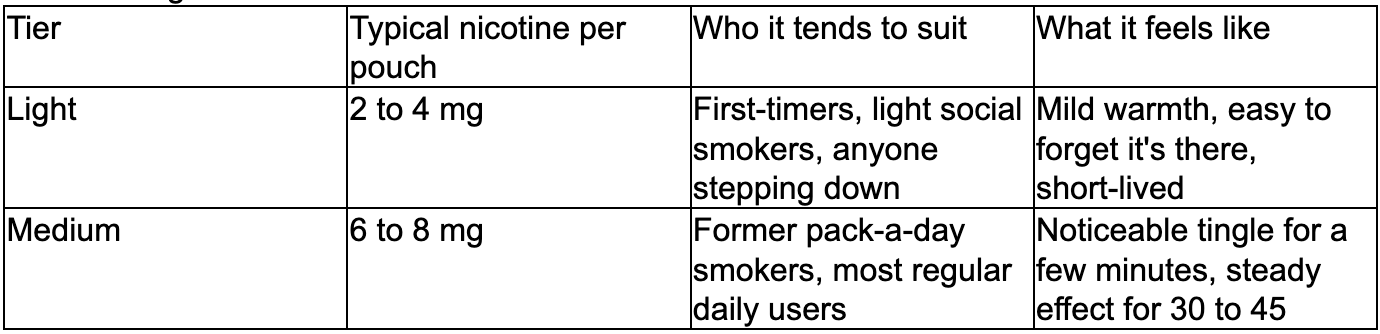
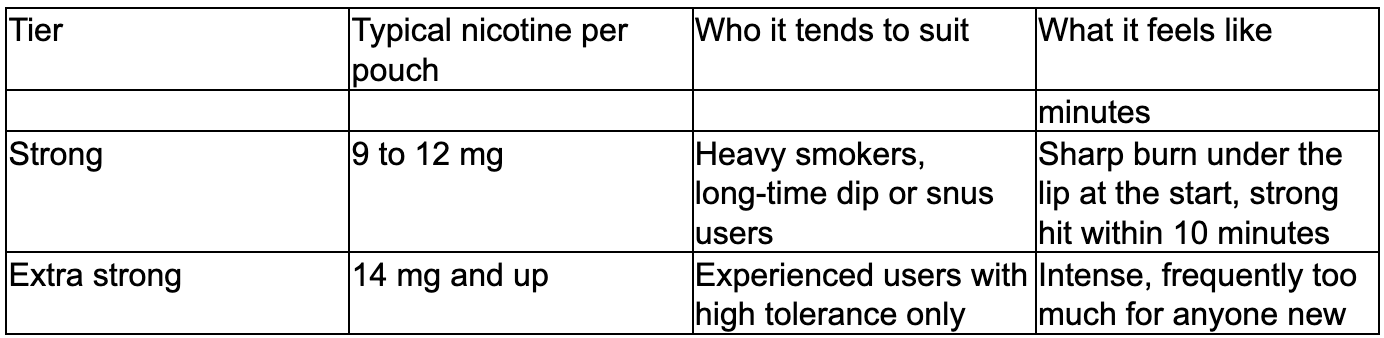
The middle band is where most people end up after a few weeks of trial and error. It delivers enough to settle a craving without the sweating and jaw-clenching that comes with overshooting.
Matching a pouch to what you already use
Your tolerance comes from your current habit, not from how tough you think you are. Three common starting points:
Coming off cigarettes
A cigarette holds somewhere around 10 to 12 mg of nicotine, and only a fraction of that reaches your blood. The delivery is what makes it feel strong: inhaled nicotine hits within seconds, a pouch takes five to ten minutes.
A pack-a-day smoker usually does fine starting in the 6 to 8 mg band. Someone smoking five a day should start lighter, at 3 or 4 mg, and move up if the cravings win.
Coming off vaping
Vapers are the hardest group to advise, since consumption is invisible. Canada caps nicotine concentration in vaping products at 20 mg/mL, and Health Canada's vaping information pages are worth a read on how that limit works.
If you're finishing a 20 mg/mL pod every day or two, a medium pouch is the sensible first purchase. Heavy all-day vapers often need the strong band to stop reaching for the device.
Coming off dip or snus
This group can usually skip the light tier entirely. Traditional moist snuff sits high on the nicotine scale, and a 3 mg pouch will feel like a breath mint. Start at 9 to 12 mg and adjust down over time if you want to reduce.
Signs you went too strong
Nicotine overshoot is unpleasant and unmistakable. The symptoms show up fast, usually inside fifteen minutes:
- hiccups that won't stop;
- a cold sweat and clammy hands;
- light-headedness when you stand up;
- nausea, sometimes with a racing heart;
- a burning sensation under the lip that goes past "tingly" into genuinely sore.
Take the pouch out, rinse your mouth, drink water and eat something. It passes within the hour. Then buy a lower strength, since pushing through it builds nothing except a bad association with the product.
Signs you went too light
The opposite problem is quieter and costs more money. You'll notice it as pouch stacking: two at a time, then a fresh one every twenty minutes, then a can gone before dinner.
If you're going through more than ten or twelve pouches a day on a light product, you're spending extra for a worse experience. Moving up one tier usually cuts consumption by a third or more.
Format matters as much as milligrams
Two pouches with identical nicotine content behave differently depending on their build. Size, moisture and fibre density all change the release curve.
Slim, mini and regular
Slim pouches are long and narrow and sit discreetly under the lip, which is why they dominate the Canadian market. Mini formats are shorter and better for anyone with a small gum pocket or a job that involves talking all day. Larger formats hold more material and tend to release for longer.
Dry versus moist
Moist pouches start fast and fade earlier. Drier ones take a few extra minutes to warm up, then hold steady for longer with less drip. A dry 8 mg pouch might feel gentler at minute three and stronger at minute twenty-five than a moist one of the same rating.
That difference catches people out when they switch brands mid-tier.
Flavour changes how strong a pouch reads
Strong mint and spearmint carry a cooling agent that hits the same nerve endings as cold. Your mouth registers that as intensity, so a 6 mg mint pouch frequently feels punchier than an 8 mg coffee or citrus one.
People who find every mint too aggressive sometimes assume they need a lower strength. What they actually need is a softer flavour at the same milligram count.
Why an old can feels weaker
Pouches lose moisture once the lid has been off a few times, and a dried-out pouch releases more slowly and less completely. The nicotine hasn't gone anywhere, but the delivery drops off.
Store cans upright, keep the lid shut, and don't judge a strength on a tin that's been in the glovebox since October.
What it costs in Toronto
Cans hold 20 pouches almost universally, which makes the per-pouch math easy. Retail pricing moves around, but the typical ranges look like this:
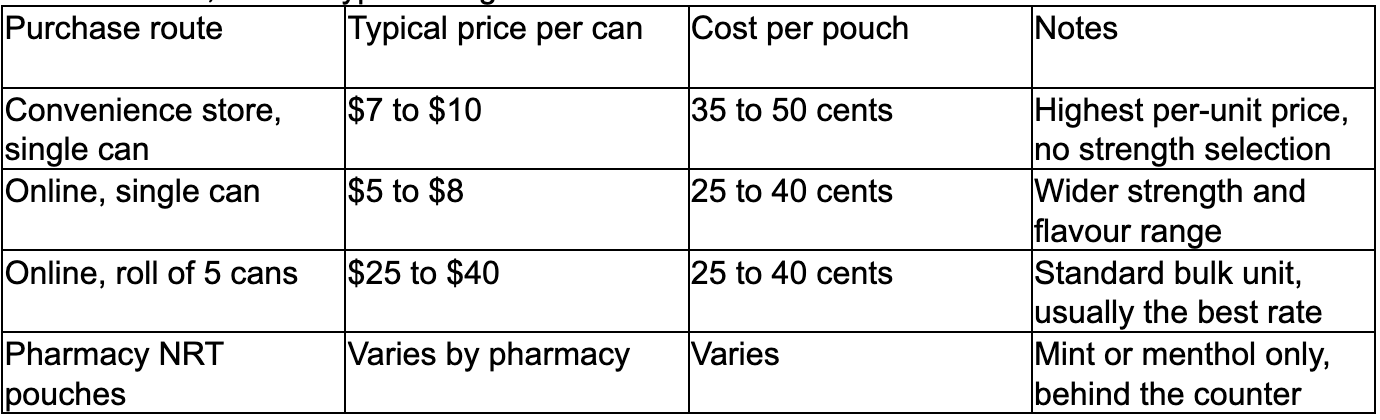
At eight pouches a day on a medium product, most users land near $60 to $90 a month. Set that beside a pack-a-day habit in Ontario, where a pack sits well north of $15 after provincial tobacco tax, and the arithmetic is the reason a lot of people make the switch in the first place.
The rules, federal and Ontario
Where you can buy them
In 2024 the federal government tightened access to nicotine pouches authorized as nicotine replacement therapy, moving them behind the pharmacy counter and limiting authorized flavours to mint and menthol. That change was aimed squarely at keeping the products away from teenagers after a wave of concern from health groups and provinces.
Products sold outside the NRT channel remain available online from retailers that run age verification at checkout. Buy from a Canadian seller with a real address and clear ingredient labelling, not from a marketplace listing with no brand information.
Where you can use them
The Smoke-Free Ontario Act, 2017 governs where you can smoke and vape: no enclosed workplaces, no enclosed public places, no restaurant or bar patios, no within nine metres of a hospital entrance. Pouches produce no smoke and no vapour, so they sit outside that framework.
Practically speaking, that means nobody on the 504 knows or cares. Individual employers, venues and airlines still set their own policies, and Ontario's minimum age of 19 for tobacco and vaping products is the benchmark most retailers apply here regardless of product class.
The health side, stated plainly
Nicotine is addictive and raises heart rate and blood pressure. Pouches remove combustion and tobacco leaf, and burning tobacco is where the bulk of smoking-related harm comes from, as Cancer Research UK explains. Pouches are still not harmless, and they are not for non-smokers.
Anyone aiming to quit nicotine entirely rather than switch delivery methods should look at structured stepping-down, and the NHS guidance on nicotine replacement therapy lays out how gradual dose reduction is normally handled.
A sensible plan for your first three cans
If you're starting from scratch, this sequence saves money and avoids the sweaty-first-pouch experience:
- Buy one light or medium can based on your current habit, not on what a friend uses;
- Try the first pouch at home after a meal, and leave it in for no more than twenty minutes;
- Note the point where the tingle fades and whether the craving actually went away;
- Run the full can before judging, since the first three pouches always feel odd;
- Adjust one tier up or down for can two, and change only the strength, not the flavour or format;
- Buy the roll once you've found the combination you stop thinking about.
Changing two variables at once is how people end up with a drawer full of half-used tins and no idea which one worked.
The honest read
Strength selection isn't a personality test. The right tier is the one that keeps you from reaching for a second pouch twenty minutes later, and for most adults switching from cigarettes that lands in the medium band rather than anything with a warning graphic on the lid.
Start lower than your ego suggests. Give each can a fair run. And keep the tin out of reach of anyone under 19, which in a city full of curious teenagers with part-time jobs and disposable income is less obvious advice than it sounds.