

Image by Wren Sutcliffe
I have lived in this city long enough to remember exactly what the spring of 2022 felt like around here. One week nobody I knew talked about legal sportsbooks, and the next week you could not watch a Leafs period or a Jays inning without a betting ad wedged into every break. Ontario flipped its regulated online market on that April, and the whole media diet of the province changed almost overnight. As someone who spends his days recording a podcast in Toronto and arguing about Blue Jays bullpen decisions, I had a front-row seat to how fast it moved.
So when the news came out this month that Alberta had opened its own regulated market on 13 July 2026, I felt a strong sense of deja vu. The province out west is now the second in Canada to run a competitive, licensed online market, and one of the familiar names on its launch roster is FanDuel. If you want the plain regulatory rundown rather than a marketing pitch, Legal Sports Report has a straightforward explainer on fanduel Alberta that walks through who regulates what and how the brand fits into the new provincial setup. I read it before writing this because I wanted to get the facts straight, not just recycle what a TV spot told me.
This is a Toronto blog, not a betting tips page, and I am not here to tell anyone to sign up for anything. What interests me is the pattern. Alberta in July 2026 looks a lot like Ontario in April 2022, and having watched one launch up close, I think there are some honest lessons about what a debut like this actually means for the people living through it.
Why FanDuel's arrival is being treated as a milestone
FanDuel is one of the biggest names in North American online betting, so its presence tends to get framed as a signal that a market has arrived. That framing is a bit of theatre. A single brand going live does not make a market safe or unsafe on its own. What actually matters is the structure sitting behind it.
In Alberta, that structure is new. The province built its market on the iGaming Alberta Act, which received Royal Assent on 15 May 2025. Two bodies share the work. The Alberta Gaming, Liquor and Cannabis Commission, known as AGLC, is the regulator, and a new entity called the Alberta iGaming Corporation runs the commercial side and holds the agreements with operators. The government also keeps running PlayAlberta.ca, its own site. If that split sounds familiar to Ontario readers, it should. It is close to the model iGaming Ontario uses, where a public body conducts and manages the market while the regulator sets and enforces the rules.
FanDuel is reported to be among the brands live at launch in Alberta, alongside a long list of others. I want to be careful with that wording, because launch rosters shift and I have not personally audited AGLC's live list. The safe way to say it is that FanDuel was among the operators available when the market opened, not that it holds some special status the others do not.
What actually changed on 13 July
Before this month, most Albertans who bet online were doing it through PlayAlberta or through offshore, grey-market sites that operated without provincial oversight. Estimates I have seen put the unregulated share of that market at around 70 percent before the launch, and that figure is worth treating as an estimate rather than a hard count. The stated goal of the regulated launch is to pull that activity onshore, where consumer protections and dispute channels exist.
More than 20 operator sites went live on day one, with reporting putting the number around 22. That is a crowded opening, and it mirrors what Ontario saw in 2022 when dozens of brands rushed in at once. For a regular person, the practical change is simple. The names you might have only seen advertised are now operating under a provincial licence rather than from somewhere offshore.
Ontario 2022 and Alberta 2026, side by side
Here is the comparison I keep coming back to, laid out plainly. The two provinces took a similar path, but they are not identical, and the differences matter.
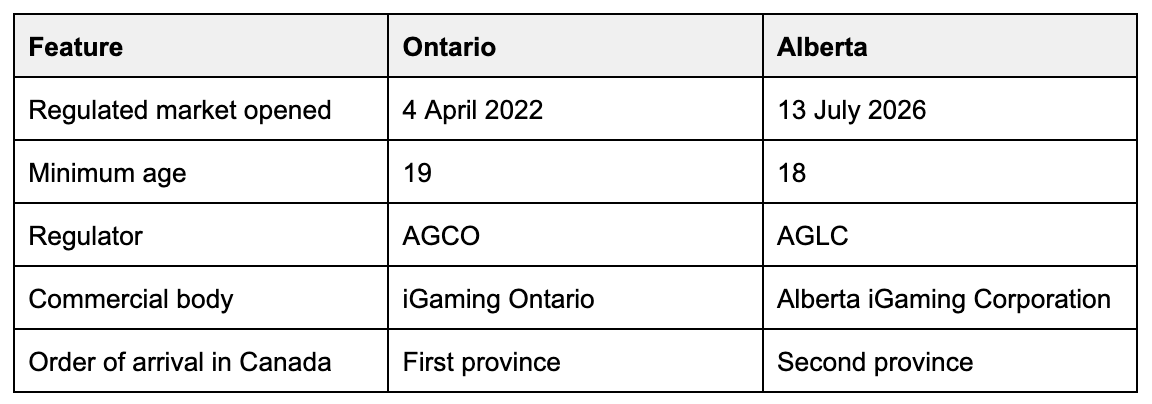
The age gap is the one I would circle for anyone who splits time between the two provinces. Ontario sets the minimum at 19, while Alberta sets it at 18. Those are not interchangeable numbers, and mixing them up is an easy mistake to make when the launches look so similar on the surface.
The honest part nobody puts in the ads
Now for the contrast, because this is where my Ontario experience actually earns its keep. When our market opened in 2022, the volume of advertising created a strong impression that everyone was doing it and that it was somehow the smart, savvy move. That impression is marketing, not math.
A regulated market gives you better odds of fair treatment, working complaint channels, and tools like deposit limits and self-exclusion. What it does not give you is an edge. Casino games are built on chance, and return-to-player figures are long-run averages spread across huge numbers of plays, not a promise about your Saturday night. Slots are pure chance. Even in a game like blackjack, solid strategy shrinks the house edge but never erases it. Being a sharp hockey watcher or a stats-fluent baseball fan does not carry over into beating a sportsbook or a slot, and any pitch that suggests otherwise is selling you something.
I think about this the same way I think about the media literacy conversation I had on a recent podcast episode about how AI slop is rotting your brain. The through-line is the same. When something is engineered to feel effortless and everywhere, that is exactly the moment to slow down and read the fine print. A licensed sportsbook launching in a new province is a regulated product, not a shortcut.
Where sports betting fits into all this
One thing worth remembering is that single-event sports betting has been legal across Canada since Bill C-218 received Royal Assent on 29 August 2021. That is the change that let provinces offer single-game wagers instead of only parlays. So the FanDuel launch in Alberta is not the arrival of legal sports betting itself. That door opened federally almost five years ago. What Alberta added this month is the regulated, competitive marketplace where licensed operators can offer it under provincial oversight.
For a sports-obsessed reader, that distinction is easy to miss because the ads blur it. Legal single-game betting and a licensed provincial market are two separate things, and Alberta only just got the second one.
What other provinces might take from this
Ontario went first, Alberta went second, and everyone else is watching. Quebec has not opened a competitive private market, so Loto-Quebec and its Espacejeux platform remain the provincially run option there. British Columbia is in a similar spot, with BCLC and PlayNow as the government operator and no private competition yet. It is fair to say those provinces are watching Alberta to see how a second open market performs. It would not be fair to say either of them has launched one, because they have not. Alberta itself set out the reasoning behind opening the market in its public iGaming strategy engagement, which frames the whole thing as a consumer-protection and market-shift exercise rather than a revenue grab.
If the Ontario experience is any guide, the noisy opening months settle into something more routine once the novelty of the ad blitz wears off. The brands that are still standing a year later tend to be the ones that treated the launch as a business rather than a fireworks show.
A quick note on playing it safe
Because this piece has spent a lot of words on a gambling launch, I want to close the practical loop. Anyone in Alberta considering these sites should know the minimum age is 18, while in Ontario it is 19. Free help and self-assessment tools exist through AGLC's GameSense program, through ConnexOntario for Ontario readers, and through responsiblegambling.org from the Responsible Gambling Council. Setting a limit before you start beats trying to claw one back later.
FAQ
When did Alberta's regulated online gambling market launch?
Alberta opened its regulated, competitive online market on 13 July 2026, making it the second Canadian province to do so after Ontario. It runs under the iGaming Alberta Act, with AGLC as regulator and the Alberta iGaming Corporation on the commercial side.
Is FanDuel actually licensed in Alberta?
FanDuel was reported to be among the operators live when the Alberta market opened, alongside more than 20 other brands. Launch rosters can change, so the accurate way to describe it is that FanDuel was one of the operators available at launch rather than claiming any special standing.
How is Alberta's market different from Ontario's?
The models are similar, with a regulator and a separate commercial body in each. The clearest difference for players is age. Alberta's minimum is 18, while Ontario's is 19. Ontario opened first, on 4 April 2022, and Alberta followed on 13 July 2026.
Does a regulated market improve my chances of winning?
No. Regulation improves consumer protections, complaint channels, and access to tools like deposit limits, but it does not change the underlying math. Casino games are chance-based, return-to-player figures are long-run averages, and no amount of sports knowledge translates into an edge over a sportsbook.
Was sports betting illegal in Canada before these launches?
Single-event sports betting became legal across Canada when Bill C-218 received Royal Assent on 29 August 2021. Provinces like Ontario and Alberta then built regulated marketplaces on top of that, so the provincial launches added a licensed market rather than legalizing betting for the first time.