
Over the recent years, professional sports in Canada completely changed their internal passport. If previously scouts and coaches in Ontario relied solely on their own intuition, watching hundreds of matches on frozen pitches, today every step of an athlete is digitized. Professional game analysis, which fans are used to seeing on specialized resources like soccer analysis, became the basis for the daily work of soccer offices. Toronto turned into a real technological hub, where soccer teams sign contracts not because of beautiful feints, but because of high mathematical performance indicators. Computer algorithms calculate the probability of injuries, model the transfer market, and create detailed plans for each game. This is no longer just a game of millions, it is a competition of gigabytes of information, where the one who reads charts and tables faster and more accurately wins.

A New Era of Scouting: Big Data Instead of Notebooks
Old methods of evaluating players are fading into the past, giving way to strict numbers. Modern Football Analytics allows evaluating the effectiveness of each football player on the pitch according to hundreds of different parameters. Special cameras installed around the perimeter of BMO Field record every action at a frequency of 25 frames per second. Coaches see not just a scored goal, but the speed of acceleration, the angle of body rotation, and the fatigue of the defender at the moment of the pass.
This cardinally changes the approach to recruitment. Instead of long business trips to South America or Europe, Toronto FC scouts simply open specialized databases. The program automatically filters out thousands of candidates according to specified criteria, leaving only those who ideally fit the tactical model of the team. This approach minimizes the risks of signing ineffective contracts, saving millions of dollars for Canadian investors.
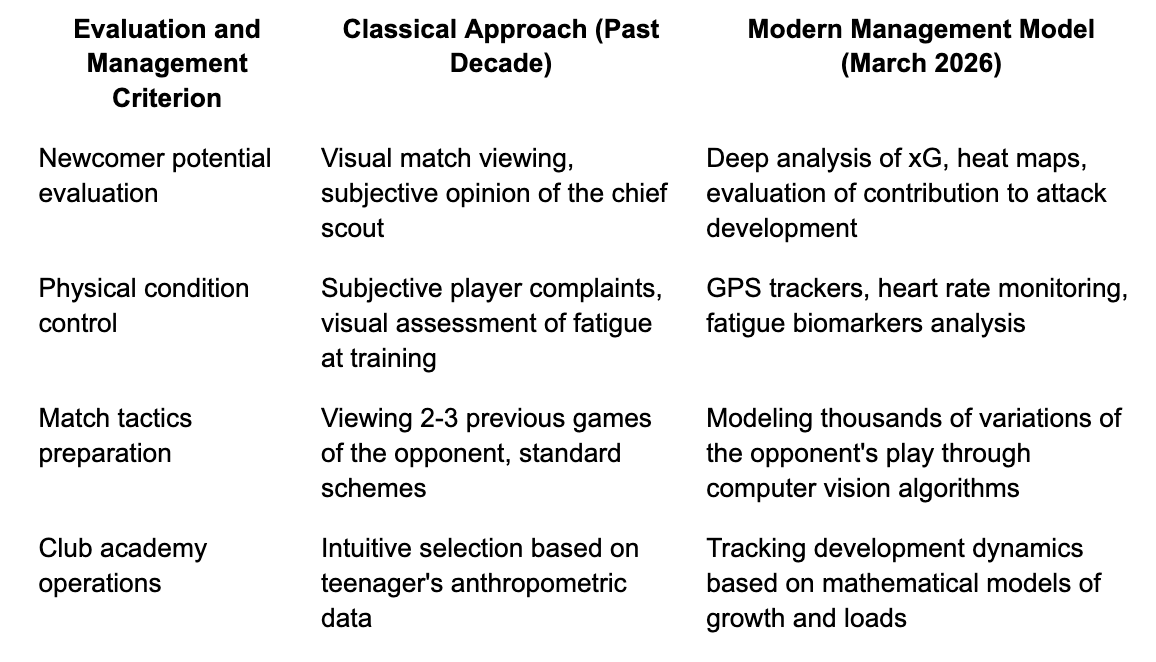
Comparison of Traditional and Analytical Approaches in Toronto Soccer
To understand the scale of changes in Canadian sports relevant for March 2026, let us look at specific workflows in team management.
Artificial Intelligence at the Coach's Service: Algorithms and Modeling
Modern Data-Driven Decisions are made not on emotions in the locker room, but in the silence of analytical offices using advanced software. Toronto clubs actively implement Machine Learning tools to process colossal arrays of information. Training models are capable of predicting how exactly the opponent team will behave if the defense scheme changes from four defenders to three. Artificial intelligence independently finds patterns in the actions of opponents that the human eye is simply not capable of noticing in 90 minutes of play.
The use of Big Data allows creating individual programs for each athlete. If the system sees that the left winger's passing accuracy drops after the 70th minute, the coaching staff adjusts the preparation plan or plans a substitution in advance. The direction of Sports Analytics turned into a separate scientific discipline, where mathematicians and programmers have the same influence on the result as physiotherapists or assistant head coaches.
Thanks to Predictive Modeling technologies, analysts calculate the mathematical probability of muscle injuries in players. A special algorithm analyzes the level of chronic load, sleep quality, and body hydration metrics. If the risk curve crosses a critical mark, the football player gets a rest, which allows the team to avoid squad crises during a tense season.
Practical Implementation of Numbers in the Training Process
The transition to a digital format requires a clear sequence of actions from the entire staff of a soccer organization. Modern Soccer Performance analytics is based on daily systematic work, which consists of several important stages.
Here is what the closed cycle of working with information looks like in a professional club from Toronto:
- Primary data collection: during each training session, players wear special vests with sensors that record speed, distance, number of accelerations, and heart rate.
- Filtration and processing: the received gigabytes of information are automatically cleaned of system noise and uploaded to club servers for further segmentation.
- Visualization for the staff: analysts translate dry numbers into clear charts, interactive maps, and reports, which are handed over to coaches two hours before the theoretical session.
- Adjusting loads: based on the reports, the head coach instantly changes the duration and intensity of exercises for specific groups of football players.
This approach makes the process of Decision Making maximally transparent and objective. Players no longer argue with the coach about their readiness, because the numbers on the monitor clearly show their real current state.
The Future of the Ontario Soccer Ecosystem
The development of technology does not stop for a single minute. In Toronto, the foundation is already being laid today for creating a unified digital database of young talents in the province. This will allow tracking promising boys and girls from early childhood, recording their progress in special registries. Canadian soccer is quickly getting rid of its catching-up status, turning into one of the leaders in the use of high technologies in North America.
Mathematical algorithms, computer modeling, and deep data analysis became an integral part of the big game. The one who hits the ball harder does not win, but the one who knows how to correctly interpret the received numbers and make the right choices based on them wins. There are even more discoveries ahead of us, because the technological revolution in Canadian soccer is only gaining its real momentum.