

Image by Mike Delaney
I have written about a lot of things from this Toronto chair over the years, but I did not expect online gambling to become one of the running stories on this blog. It sort of forced its way in. Back in the spring of 2022, right around the time the Leafs were doing their usual playoff thing to my heart, the ads showed up. All at once, it felt like. Every commercial break during a Raptors or Jays broadcast turned into a parade of betting apps, celebrity pitchmen, and sign-up offers. One week it was the grey market nobody talked about in polite company. The next week it was a legal, licensed business buying up half the ad inventory in Ontario sports media.
That was April 4, 2022, the day Ontario switched on the first regulated, competitive online gambling market in Canada. Four years later I keep an eye on how the rest of the country reacts to what we did here, and the province worth watching right now is Alberta. Bonus.com has been putting together plain-language guides on what a legal online casino in alberta will actually mean for players out west, and reading their Alberta breakdown sent me straight back to my own memories of the Ontario rollout. The parallels are almost uncomfortable.
So this is not another explainer about Bill 48 written by someone who has never lived through one of these launches. This is a note from a guy in Ontario who watched the whole thing happen, made mistakes as a consumer, learned a few things, and can tell you what four years of hindsight says about the road Alberta is about to drive down in the summer of 2026.
What actually happened in Ontario on April 4, 2022
Here is the part that surprised most of my Friends of the Mike when I explained it on the podcast. Online casinos and sportsbooks were not banned in Ontario before 2022. Plenty of people were already playing on offshore sites that operated in a legal grey zone. What changed on April 4 was not that gambling became possible. It became regulated.
The province set up two bodies to run the show. The Alcohol and Gaming Commission of Ontario, the AGCO, became the regulator, the one that writes and enforces the standards. A separate outfit called iGaming Ontario, usually shortened to iGO, was created as a subsidiary of the AGCO to hold the commercial agreements with the operators. A company had to register with the AGCO and sign an operating agreement with iGO before it could legally take a single bet from an Ontario resident. That two-step gate is the whole trick, and remember it, because Alberta copied the structure almost line for line.
The stated goal was never really about creating gambling. It was about channelization, a clunky word that just means moving players off the unregulated sites and onto ones that follow Ontario rules on fairness, age checks, and anti-money-laundering. The pitch to skeptics like me was simple. People are already doing this. Would you rather they did it somewhere with player protections and a regulator, or somewhere with neither.
The numbers, once the dust settled
I am naturally suspicious of launch-day hype, so I waited to see the receipts. They came, and they were bigger than I expected.
According to iGaming Ontario's own reporting, the first full fiscal year of the market produced roughly 35.5 billion dollars in total wagers and around 1.26 billion dollars in total gaming revenue. By the end of that first year something like 46 operators had signed operating agreements, and the market counted well over 1.6 million active player accounts. For a province of our size, those are serious numbers, and they pushed Ontario into the conversation with the biggest gaming jurisdictions in North America within a year.
The early quarters were smaller, which matters for anyone in Alberta setting expectations. The very first market report, covering April through June of 2022, showed fewer than 20 operators live and revenue in the low hundreds of millions. The big totals came later, partly because there was a transition deadline in the fall of 2022 that pushed grey-market operators to either go legal or get out. The lesson for Alberta is patience. A regulated market does not arrive fully grown on day one. It fills in over the first year.
Alberta is following the map, not redrawing it
When I read about Alberta's plan, my first reaction was that someone in Edmonton clearly kept a copy of the Ontario playbook on the desk.
The enabling law is the iGaming Alberta Act, better known as Bill 48, which received royal assent in the spring of 2025. It sets up the same kind of two-body system Ontario uses. The Alberta Gaming, Liquor and Cannabis commission, the AGLC, plays the regulator role that the AGCO plays in Ontario. A new provincial corporation, the Alberta iGaming Corporation or AiGC, takes the iGO role of holding the commercial agreements operators need before they can go live. Same two-step gate. Register with the regulator, then reach an agreement with the conduct-and-manage body.
The big difference is what came before. Ontario was replacing a loosely policed grey market plus the provincial lottery. Alberta is moving past PlayAlberta, the single online site the AGLC has run on its own for years, and opening the door to private competitors alongside it. So Alberta is not going from zero to a hundred. It is going from one legal option to many.
The launch is expected in the middle of July 2026. I am hedging that date on purpose, because I remember how these timelines can wobble, but reporting through the first half of 2026 has pointed at a mid-July opening with a couple dozen operators cleared to launch. If that holds, Alberta becomes the second Canadian province, after Ontario, to run a genuinely competitive regulated market.
Ontario versus Alberta, side by side
I put together a quick comparison for the podcast notes, and it is worth dropping here so you can see how closely the two provinces line up, and where they part ways.
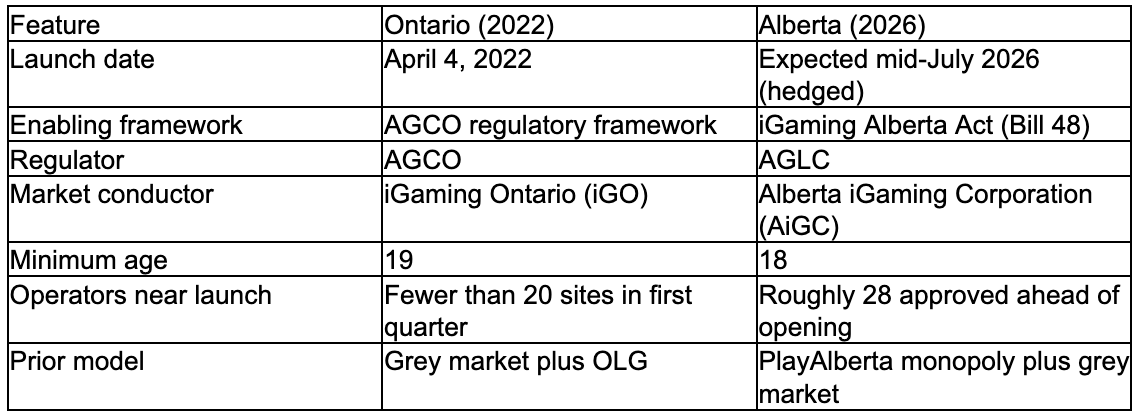
The one difference that jumps out at me is the age line. Ontario sets the floor at 19, matching our drinking age. Alberta sets it at 18, matching theirs. It is a small thing on paper, but it means an 18-year-old in Calgary will have legal access to something an 18-year-old in Toronto still cannot touch. Worth knowing if you have kids heading off to school in either province.
What Ontario got right that Alberta can copy
Credit where it is due. The channelization worked better than I thought it would. Survey work done about a year into the Ontario market suggested that a large majority of people who gambled online, somewhere around 85 percent in one Ipsos read, were doing it on regulated sites rather than offshore ones. That was the entire point, and it mostly landed.
The player-protection scaffolding is the other win. Registered operators have to meet standards on game integrity, identity and age verification, and self-exclusion tools that simply were not guaranteed on the offshore sites people used before. If you had a gambling problem in 2020 and were playing on some site registered three countries away, good luck getting help. Under the regulated model there is at least a clear regulator, a complaints process, and mandatory responsible-gambling features. Alberta is building the same protections in, and that is the part I actually care about as a parent and a community guy.
What Ontario fumbled that Alberta should watch
Now the uncomfortable part, and this is where my Ontario experience turns into a genuine warning.
The advertising got out of hand. Fast. For a good stretch after launch, you could not watch a Leafs game without a betting ad every few minutes, often with a famous face telling you it was easy money. The backlash was real, and the regulator eventually tightened the rules, including limits on using athletes and celebrities to pitch to a general audience. Alberta has a chance to set sensible ad guardrails before the flood rather than after, and I hope someone out there is paying attention to how loud it got here.
The media-money side is its own story. When gambling cash poured into sports broadcasting, it reshaped the economics of the whole business, and not always in ways that helped local media. I have watched the traditional side of that business struggle in real time. When I wrote about Rogers shutting down a batch of its AM radio stations, a lot of the reader mail circled back to how ad dollars have shifted and consolidated. Betting money is a big part of that shift. Alberta's media scene will feel the same pull, and it is worth naming honestly rather than pretending the money is free.
The money question, and why your winnings probably are not taxed
This is the question I get most from Friends of the Mike, so let me be clear and careful. In Canada, gambling winnings for a recreational, casual player are generally not treated as taxable income. If you are an ordinary person having a flutter on a Saturday, your winnings are usually yours to keep, in Ontario and in Alberta alike.
The line moves if gambling stops being recreation and becomes a business, the way it can for a professional poker player who treats it as a livelihood. That is a real and specific carve-out, not something that touches most people. I am a blogger, not an accountant, so if your situation is complicated, talk to someone who does taxes for a living. The general point stands. For the average Albertan playing on a regulated site for fun, a win is not a tax event.
One accuracy note, because it matters. A regulated Alberta operator is not the same thing as an offshore site that happens to accept Alberta players. The regulated ones sit under the AGLC and the AiGC, with the protections that come with that. When the market opens, knowing which is which is the single most useful piece of consumer knowledge you can carry.
How to read the operator rush without getting dizzy
Alberta is opening with a couple dozen approved operators, and if Ontario is any guide, that number climbs over the first year. That is a lot of brands shouting at once, and it is easy to get overwhelmed.
My advice, learned the hard way in 2022, is to slow down. Check that a site is actually on the regulated list before you hand over a dollar. Read the responsible-gambling tools, the deposit limits, and the self-exclusion options, because those are the things you will be glad exist if you ever need them. Comparison guides that lay operators out side by side, rather than pushing one brand, are genuinely useful for this. Treat the whole thing the way you would treat picking a bank, not the way you would treat grabbing a lottery ticket at the corner store.
What it looks like from my Toronto chair
I am not here to tell you gambling is good or bad. I have watched enough of it up close to know it is a bit of both, depending entirely on the person and the guardrails. What I can tell you is that Ontario proved a regulated market can pull most people out of the shadows, fund some public services, and still create real problems around advertising and access that need active management.
Alberta is about to learn the same lessons on a compressed timeline, with the Ontario file sitting right there as a study guide. If you want the official version of how Ontario's first year actually shook out, the annual reporting from iGaming Ontario's first-year results is the primary source I keep going back to, and it beats any secondhand summary, including mine. Read it, then watch Alberta, and you will see the same movie playing on a different screen.
Frequently Asked Questions
Did Ontario and Alberta make online gambling legal, or just regulated?
Regulated is the accurate word. In both provinces people were already playing on offshore grey-market sites beforehand. The 2022 Ontario launch and the 2026 Alberta launch created a licensed, provincially regulated version with age checks, player protections, and a regulator to complain to, rather than inventing gambling from scratch.
Why can an 18-year-old gamble legally in Alberta but not in Ontario?
Each province sets its own minimum age to match its own rules, and it lines up with the local drinking age. Ontario sets the floor at 19 and Alberta at 18. So a legal online casino in Alberta will be open to 18-year-olds, while an Ontario resident has to wait until 19.
Are my winnings taxed if I play on a regulated Alberta site?
For a casual, recreational player in Canada, gambling winnings are generally not taxable income, and that applies in Alberta as it does in Ontario. The exception is when gambling functions as a business or profession, which is a narrow situation. If your circumstances are unusual, get proper tax advice rather than relying on a blog.
How many operators will Alberta have at launch?
Reporting ahead of the expected mid-July 2026 opening pointed to roughly 28 approved operators, with more in the queue. If Alberta follows Ontario's pattern, that count should grow through the first year as more brands complete registration with the AGLC and sign agreements with the Alberta iGaming Corporation.
What is the single biggest thing Alberta should learn from Ontario?
Manage the advertising early. Ontario let betting ads saturate sports broadcasts before tightening the rules, and the public backlash was significant. Setting sensible limits on volume and celebrity pitches from the start would spare Alberta the same headache while keeping the consumer protections that made the regulated model worth building.