

If you've lived through a Toronto summer lately, you already know the drill. The sky goes green over the Don Valley, the rain comes sideways, and somewhere in the back of your mind a little voice asks: is the basement okay? For a lot of Toronto homeowners, that voice turned out to be right. The July 16, 2024 storm dropped nearly 100 mm of rain on Pearson in a single morning, more than a usual month's worth, flooded the DVP, and racked up close to a billion dollars in insured damage across the city and southern Ontario. Basements from Etobicoke to Scarborough filled up.
So two questions come up again and again. First, does basement waterproofing work, or is it just an expensive promise? Second, how much does basement waterproofing cost in Toronto in 2026? This post answers both. We'll walk through how to waterproof a basement, what drives the price up or down, the real per-linear-foot numbers for Toronto this year, and the City of Toronto rebates that can knock thousands off your bill. By the end you'll know roughly what to budget and what questions to ask before you sign anything.
A quick note on who's writing this. I'm with DrainCom Basement Waterproofing, and they've spent more than two decades fixing wet basements across Toronto and the GTA. We've waterproofed over 20,000 homes and laid hundreds of thousands of feet of weeping tile and membrane in Toronto's exact soil. So when I talk about clay and hydrostatic pressure below, it's not theory. It's most of our Tuesdays.
Does Basement Waterproofing Work?
Short answer: yes, when it's diagnosed and installed properly. The long answer is worth your time, because "properly" is doing a lot of heavy lifting in that sentence.
Water gets into a Toronto basement through a few predictable paths. Foundation cracks are the big one. Roughly half of all basement leaks trace back to a crack in the foundation wall. Water also pushes up through the joint where the floor meets the wall, seeps through porous concrete, or backs up through the floor drain when the city sewer is overwhelmed. Each path has a matching fix. The trick is matching the right solution to the right problem, which is why a real inspection at your Toronto address beats a phone quote every single time.
Here's the part homeowners don't always hear. Waterproofing isn't one product. It's a system. So how do you waterproof a basement? Done from the outside, it means excavating down to the footing, cleaning the wall, repairing cracks with hydraulic cement, applying a foundation sealer and a waterproofing membrane, and installing or replacing the weeping tile. Done from the inside, it means breaking up the floor along the perimeter, installing a new weeping tile pipe, applying a Delta MS drainage membrane, and routing everything to a sump pump or storm drain. Both work. They just suit different situations.
When you hear someone say basement waterproofing didn't work, it's almost always one of three things: the wrong method for the problem, a cut-rate patch instead of a full system, or a leak that was never properly diagnosed in the first place. A trained eye and the right diagnostic tools change that outcome completely.
Why Toronto Basements Flood More Than Most
Toronto is, frankly, a tough town for basements, and there are good reasons for that.
A lot of our housing stock - the brick semis in Leslieville, the older homes in the Beaches, East York, and the Annex - went up in the mid-1900s or earlier, back when waterproofing tech was rough and building standards were looser. Older Toronto homes often have little or no exterior weeping tile, which leaves them wide open to seepage. On top of that, much of Toronto sits on clay soil. Clay doesn't drain like sand. Water hits it and just sits there, or slides sideways until it finds a crack in your wall. That standing water builds hydrostatic pressure, and pressure is what drives water through concrete.
Then there's the weather. We're getting fewer gentle all-day drizzles and more short, violent downpours that dump a month of rain in an hour. Toronto's sewer system, much of it aging and in older neighbourhoods still combining storm and sanitary lines, was not built for that. When the system maxes out, water comes back up through floor drains into basements. Add paved-over driveways and patios that can't absorb runoff anymore, and you've got a recipe for a wet basement. This is exactly why proactive basement waterproofing has gone from "nice to have" to "smart insurance" for most Toronto homeowners.
How Much Does It Cost to Waterproof a Basement in Toronto? (2026 Numbers)
Let's get to the part you came for. So, how much does it cost to waterproof a basement in Toronto? Basement waterproofing is usually priced per linear foot of foundation wall, and the 2026 Toronto market sits in these ranges:
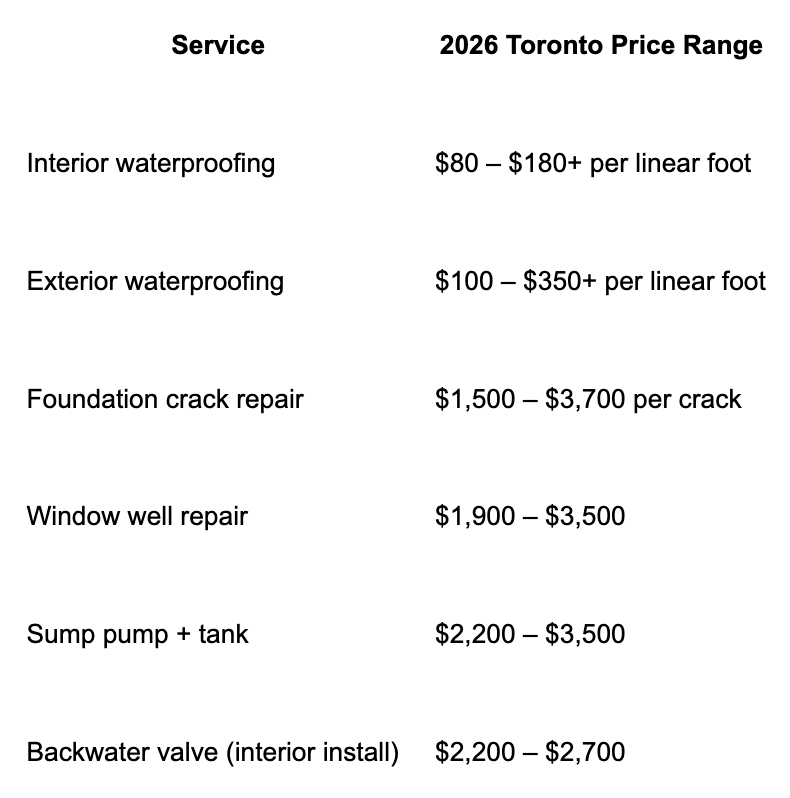
For a full project, most Toronto homeowners land somewhere between $8,000 and $35,000 depending on scope. A typical home has 100 to 150 linear feet of foundation wall, so the math adds up quickly once you multiply. That's the honest answer to how much to waterproof a basement in this city.
Interior waterproofing tends to cost less because it usually avoids digging. Exterior waterproofing costs more because it involves excavation, wall prep, membrane, a new drainage system, and putting your yard back together. It's more labour, but it stops water before it ever touches your foundation, which is why it's often the better call for older Toronto homes with stubborn, recurring leaks.
These are market estimates, not a quote. Two houses on the same Toronto street can price out very differently, which brings us to the next part.
What Actually Moves the Price

Six things push your number up or down, and a good contractor will walk you through every one of them on site.
- Excavation depth. Toronto foundations usually run 5 to 8 feet deep. A 9-foot foundation costs noticeably more to dig than a 6-foot one.
- Soil type. Remember that clay? It can cost 25 to 50 percent more to excavate than sandy soil because it's dense, heavy, and stubborn.
- Accessibility. A narrow side yard on a tight downtown lot, a neighbour's wall right next door, or a slope can force hand-digging or specialized equipment, both of which add labour.
- Interior vs. exterior method. Different processes, different price tags, as the table above shows.
- Length of wall treated. More linear feet means a bigger bill, though larger jobs often earn a lower per-foot rate.
- Condition of the wall. A wall that needs crack repair or rebuilding before waterproofing adds cost.
This is also why a free, on-site inspection matters so much. Anyone quoting you a firm price over the phone, sight unseen, is guessing.
The City of Toronto Rebates That Cut Your Bill (This Part Is Big)
Here's the good news Toronto homeowners often miss: the City of Toronto will help pay you to flood-proof your basement.
The City of Toronto's Basement Flooding Protection Subsidy Program covers up to 80 percent of the cost of approved flood-prevention work. The City expanded the program effective May 1, 2026, lifting the maximum to up to $6,650 per property, a big jump from the old $3,400 cap. Eligible work completed on or after November 12, 2025 may qualify under the enhanced amounts.
Under the expanded program, you can claim up to $1,600 per backwater valve (for up to two valves), up to $2,250 for a sump pump, up to $300 for a sump pump battery backup, up to $400 for weeping tile severance and capping, and up to $500 for a home plumbing assessment. Funding is first-come, first-served and tied to the City's annual budget, so it pays to move early.
A few rules to keep in mind. The work must be done by a City of Toronto-licensed contractor, homeowner DIY isn't eligible, and you'll need your downspouts disconnected from the sewer and itemized invoices to apply. If you own property just outside the city limits, neighbouring municipalities in Peel and Halton run their own programs, but for Toronto proper this is your rebate.
At DrainCom we handle the City paperwork, permits, and inspection coordination so the rebate actually lands. A rejected invoice can sink your claim, and getting it right the first time is half the job.
How a Real Waterproofing Job Goes
People picture jackhammers and chaos, and yes, there's some of that. But a proper job follows a clear sequence. If you've ever wondered how to waterproof a basement step by step, here's the short version.
For exterior work, we excavate to the footing, clean the foundation wall, repair any cracks or bad mortar joints, apply a waterproofing membrane to create a continuous barrier, install drainage at footing level to carry groundwater away, then backfill and restore your yard. Done right, the only thing you'll notice afterward is a dry basement.
For interior work, we start with a free inspection to find the root cause, clear and protect the space, install an interior drainage system and sump pump, seal cracks and joints, then test the system to confirm no water gets through. It's less disruptive to your landscaping and ideal for finished basements or tight Toronto lots where you can't get a machine around the side of the house.
Either way, the goal is the same: find the source, fix it at the source, and back it up with a warranty. Ours runs 25 years and is transferable, which also happens to be a nice selling point if you list the house down the road.
Applications: Where a Dry Basement Actually Pays Off
A waterproofed basement isn't just about avoiding a soggy mess. It opens doors, literally and figuratively.
Once your basement stays dry, that square footage becomes usable. We've seen Toronto homeowners turn damp, musty cellars into rec rooms, home offices, gyms, and full rental apartments, especially when basement lowering or a walkout entrance is added to the plan. A legal basement apartment is real monthly income in Toronto's rental market. Beyond the cash, waterproofing protects your foundation from cracks and erosion, kills the conditions that grow mould and mildew, improves indoor air quality, and bumps up your resale value. In a market where Toronto homes trade at the prices they do, water issues are deal-breakers when it's time to sell, so fixing them early protects the biggest investment most of us will ever make.
Frequently Asked Questions
How much does it cost to waterproof a basement in Toronto in 2026? Interior waterproofing runs roughly $80 to $180+ per linear foot, and exterior runs about $100 to $350+ per linear foot. Most full Toronto projects land between $8,000 and $35,000 depending on depth, soil, access, and the method used.
Does basement waterproofing work? Yes, when the leak is diagnosed correctly and a full system is installed rather than a quick patch. About half of basement leaks come from foundation cracks, and each entry path has a matching fix. The failures you hear about usually come from the wrong method or a skipped diagnosis.
How do you waterproof a basement, inside or outside? It depends on the leak source, how accessible the foundation is, and how deep the basement sits. Exterior stops water before it reaches the wall and suits older Toronto homes with recurring leaks. Interior is less disruptive and works well for finished basements or tight lots. A free inspection settles it.
How long does the work take? A focused job like a sump pump or backwater valve install is often a single day. A full exterior waterproofing project takes longer depending on excavation depth and weather. We give you a realistic timeline after the on-site assessment.
Can I get a City of Toronto rebate? Yes. The City of Toronto's expanded subsidy offers up to $6,650 per property for approved flood-prevention work. The work has to be done by a City-licensed contractor, and we handle the paperwork.
Do you come out to my place in Toronto to assess it? We do. We offer a free, no-obligation on-site inspection across Toronto. That's the only way to give you an accurate price, because phone quotes are guesses.
The Bottom Line for Toronto Homeowners
Basement waterproofing works, the cost is more manageable than most people expect once City rebates are in play, and the price hinges on factors a good contractor can explain in plain language during a free inspection. Given Toronto's clay soil, aging homes, and increasingly wild storms, doing nothing is the genuinely expensive option.
If you want a straight answer about your own basement, reach out to the team at DrainCom Basement Waterproofing, the expert basement waterproofing company serving Toronto and the Greater Toronto Area. You can also check their basement waterproofing reviews on Google before you book. No pressure, no upsell, just an honest look at what your home actually needs.