
Artificial intelligence has rapidly transformed from a futuristic concept into a core driver of modern digital innovation. Among the most influential players in this space, OpenAI has emerged as a leader shaping how businesses, individuals, and entire industries interact with intelligent systems. The growing global interest in OpenAI stock reflects not just financial curiosity but also the massive impact AI is having on productivity, automation, and decision-making across sectors.
As AI adoption expands, OpenAI’s influence continues to grow beyond traditional software boundaries. Its technologies are integrated into education, healthcare, finance, and enterprise solutions, redefining how information is processed and utilized. This increasing relevance has positioned OpenAI as a key benchmark in the evolving artificial intelligence economy, attracting investors, developers, and policymakers worldwide.
The Rise of AI Giants and the Value Behind Innovation
The artificial intelligence industry has become one of the fastest-growing sectors in the global economy. Companies leading this transformation are not only developing advanced technologies but also redefining market expectations and digital capabilities.
Understanding the rise of AI leaders helps explain why interest in OpenAI stock continues to grow among analysts and investors seeking exposure to the future of technology.
Key Drivers of AI Market Expansion and Influence
1. Rapid Adoption Across Industries
Artificial intelligence is being adopted across multiple sectors, including healthcare, finance, retail, and logistics. Businesses use AI to automate processes, improve decision-making, and enhance customer experiences. This widespread adoption has significantly increased the demand for advanced AI models and platforms.
2. Breakthroughs in Generative AI
Generative AI has revolutionized content creation, coding, design, and communication. Models capable of producing human-like text, images, and code have unlocked new commercial opportunities, increasing the strategic value of companies leading this innovation.
3. Expansion of AI Infrastructure
The growth of AI requires powerful computing infrastructure, including cloud platforms and high-performance chips. This ecosystem expansion has created a strong foundation for continuous innovation and scalability.
4. Increasing Enterprise Integration
Organizations are integrating AI tools into their core operations to improve efficiency and reduce operational costs. This enterprise adoption is driving long-term demand for AI technologies and solutions.
5. Investor Interest in AI Markets
The financial sector is closely monitoring AI companies due to their high growth potential. Investors view AI as a long-term opportunity, contributing to rising valuations and market attention.
6. Continuous Research and Development
Ongoing research in machine learning and deep learning ensures continuous improvements in AI capabilities. This innovation cycle strengthens the competitive position of leading AI organizations.
Understanding the AI Ecosystem and Market Positioning
The AI ecosystem is composed of interconnected technologies, platforms, and services that collectively drive innovation. OpenAI plays a central role in this ecosystem, influencing development standards and industry trends.
Below is an overview of how different components interact within the AI market landscape:
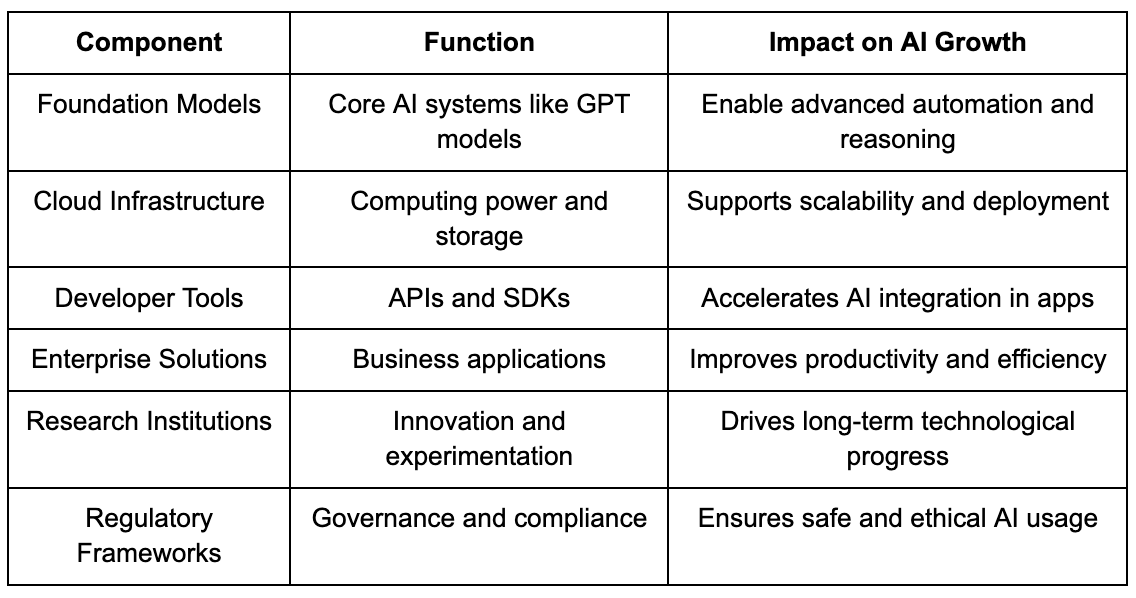
This ecosystem demonstrates how AI development is not isolated but deeply interconnected across industries and technologies.
How OpenAI Influences the Global Technology Landscape
OpenAI has become one of the most influential forces in shaping the direction of artificial intelligence. Its models and tools are widely used across industries, making it a central player in global digital transformation.
The growing discussion around OpenAI stock highlights the company’s perceived value in the future of AI-driven economies.
Major Areas of OpenAI’s Influence
1. Transformation of Digital Communication
AI-powered language models have changed how people communicate, write, and interact with technology. From chatbots to content generation, communication has become faster and more efficient.
2. Revolutionizing Software Development
Developers now use AI tools to write, debug, and optimize code. This has significantly reduced development time and improved software quality across industries.
3. Enhancing Business Productivity
Organizations use AI systems to automate workflows, analyze data, and improve decision-making processes, leading to higher productivity and efficiency.
4. Advancing Education and Learning
AI tools are being used in education to provide personalized learning experiences, tutoring assistance, and research support for students and educators.
5. Supporting Creative Industries
From writing and design to music and video production, AI is enabling new forms of creativity and content generation.
6. Driving Ethical AI Discussions
OpenAI has also played a key role in promoting responsible AI usage, safety research, and ethical development practices.
The Market Perspective: Growth, Value, and Expectations
The market perception of AI companies is driven by their innovation potential, scalability, and real-world applications. While OpenAI is not publicly traded in the traditional sense, its influence significantly impacts investor sentiment and AI-related market trends.
The discussion around valuation is often tied to future potential rather than current financial metrics alone.
Key Market Factors Influencing AI Valuation
1. Technological Leadership
Companies leading in AI innovation tend to attract higher market interest due to their ability to shape future technologies.
2. Scalability of AI Solutions
The ability to deploy AI solutions across industries increases long-term value potential.
3. Strategic Partnerships
Collaborations with major technology firms enhance credibility and market reach.
4. Demand for Automation
Increasing demand for automation across industries boosts AI adoption rates globally.
5. Data Accessibility
Access to large datasets improves model accuracy and effectiveness, increasing system value.
6. Future Market Expansion
AI is expected to expand into new industries such as robotics, autonomous systems, and advanced analytics.
Conclusion
The rise of artificial intelligence marks one of the most significant technological transformations of the modern era. As innovation accelerates, companies like OpenAI continue to play a central role in shaping the future of digital intelligence, influencing industries, economies, and global innovation standards. The increasing interest in OpenAI stock reflects broader confidence in the long-term potential of AI-driven technologies.
While OpenAI itself remains a private entity, its impact on markets and technological advancement is undeniable. It serves as a benchmark for innovation, guiding the direction of AI development worldwide. As AI continues to evolve, its influence will only deepen across industries and economies.