
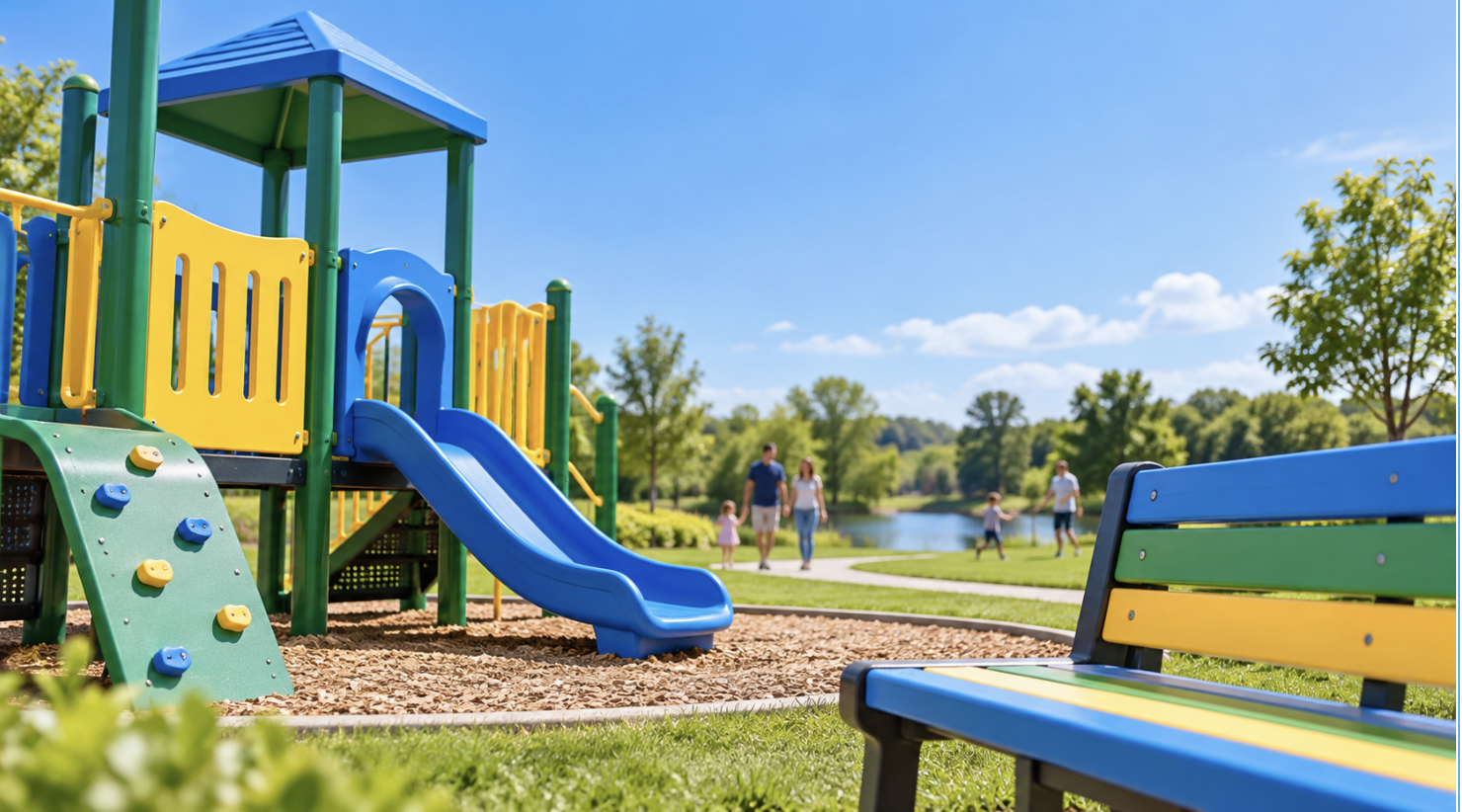
A park bench has a hard life. It sits outside year-round, holds up under everyone who sits on it, and rarely gets more maintenance than an occasional hose-down. Playground equipment has it worse, with kids climbing, kicking, and hanging off it from open to close. Whoever picks the material for these installations is really deciding how they'll look and hold up a decade from now, usually on a budget that leaves little room for repairs.
That pressure is why parks departments and the fabricators who build for them keep landing on high-density polyethylene. It handles weather, wear, and years of hands-off use better than the wood and metal it replaces.
What Public Furniture Is Up Against
Outdoor seating and play structures face a stack of problems at once. Sunlight fades and cracks almost anything that sits in it. Rain and snow rot wood and rust steel. Then there's the human factor: carved initials, spray paint, gum, spilled drinks, and the occasional skateboard grinding across an edge.
Wood handles some of this at first, but it splinters, greys, and rots where water collects, and it needs sanding and resealing to stay presentable. Painted metal looks sharp on install day, then chips and rusts at every scratch, and bare metal bakes in summer sun hot enough to burn a kid's hands and legs. Both materials tend to fail slowly, turning into a repair list a small parks crew never quite catches up on.
Why HDPE Holds Up Outdoors
HDPE sidesteps most of that. It doesn't rot, rust, or soak up water, so freeze-thaw cycles and standing puddles don't wreck it. UV stabilizers keep it from going brittle and chalky after years in direct sun. You'll find it doing the quiet work all over a park: bench slats, picnic tables, boardwalk decking, planters, signposts, and trash and recycling enclosures that would rot or rust in any other material.
The real advantage for public spaces is how it takes abuse. The color runs all the way through the material instead of sitting on top as paint, so a scratch or a gouge shows the same color underneath instead of bare substrate. Most graffiti wipes off the slick surface, and what doesn't can be scrubbed without stripping a finish. No repainting, resealing, or staining is on the calendar, which is exactly what a stretched maintenance budget needs.
Built for Kids and Families
Safety and comfort matter more on equipment people touch all day. HDPE stays smooth as it ages, so bench slats and climbing panels have no splinters. It doesn't heat up like bare metal, and lighter colors can be specced for surfaces that sit in full sun. Rounded, sanded edges come standard on fabricated parts, which keeps sharp corners off the playground.
It cleans up easily too. A bench that's been through a birthday party or a muddy afternoon hoses right off, with nothing soaking into the grain and no rust bleeding out of the fasteners.
The Recycled Angle Parks Like
A lot of these purchases run through public budgets and public opinion, and recycled content is an easy win on both. Recycled HDPE puts diverted plastic to work instead of new petroleum stock, so a bench or a play panel can carry a real sustainability story rather than a vague one. For a city or a school weighing where the money goes, "made from recycled plastic and built to outlast the last three we replaced" is a straightforward pitch.
Matching the Install with Custom Fabrication
Stock furniture rarely fits a specific site cleanly. A themed playground, an ADA-compliant seating area, or a bench sized to a particular pad all need made-to-measure parts. Ordering custom HDPE cut to your drawings removes the guesswork. CNC cutting holds tight tolerances on slots, bolt holes, and radiused corners, so panels and slats arrive ready to assemble instead of needing on-site trimming and drilling.
That precision pays off across a batch. When you're building a run of matching tables or a whole play structure, sending one spec and getting identical parts back keeps the set consistent and cuts the labor of fitting each piece by hand. A supplier can hold your dimensions on file and turn out the same parts for the next phase or the next park.
Color, Shape, and Curb Appeal
None of this means settling for a plain gray box. HDPE sheet comes in a wide range of solid colors, so a fabricator can match school colors, a park's palette, or a playground theme without painting anything. The color won't fade off or chip away, because it's the material itself. That opens up bright, welcoming builds that still shrug off weather and wear years later.
Public furniture is one of those purchases where the cheap option gets expensive fast, through repairs, repainting, and early replacement. Building with HDPE, cut to fit the site, front-loads a little planning to skip most of that. For a parks department or a fabricator who'd rather install it once and move on, it's the material that makes the math work.