
A radiator showed up at a shop I know last spring. Right box, right branding, right part number on the label. The price was about forty percent under what everyone else was quoting, which the buyer took as a win. It lasted nine days on the road before it let go somewhere past Kingston, and by the time the truck was back in a bay, the bill had stopped being about a radiator at all.
That story is not rare anymore. Counterfeit truck parts have become one of the quieter problems in trucking, and they are getting harder to spot. Not because the fakes are brilliant, but because the way we buy parts has changed. Most people now order through a screen, from a seller they will never meet, and the only thing they can inspect before paying is a photograph.
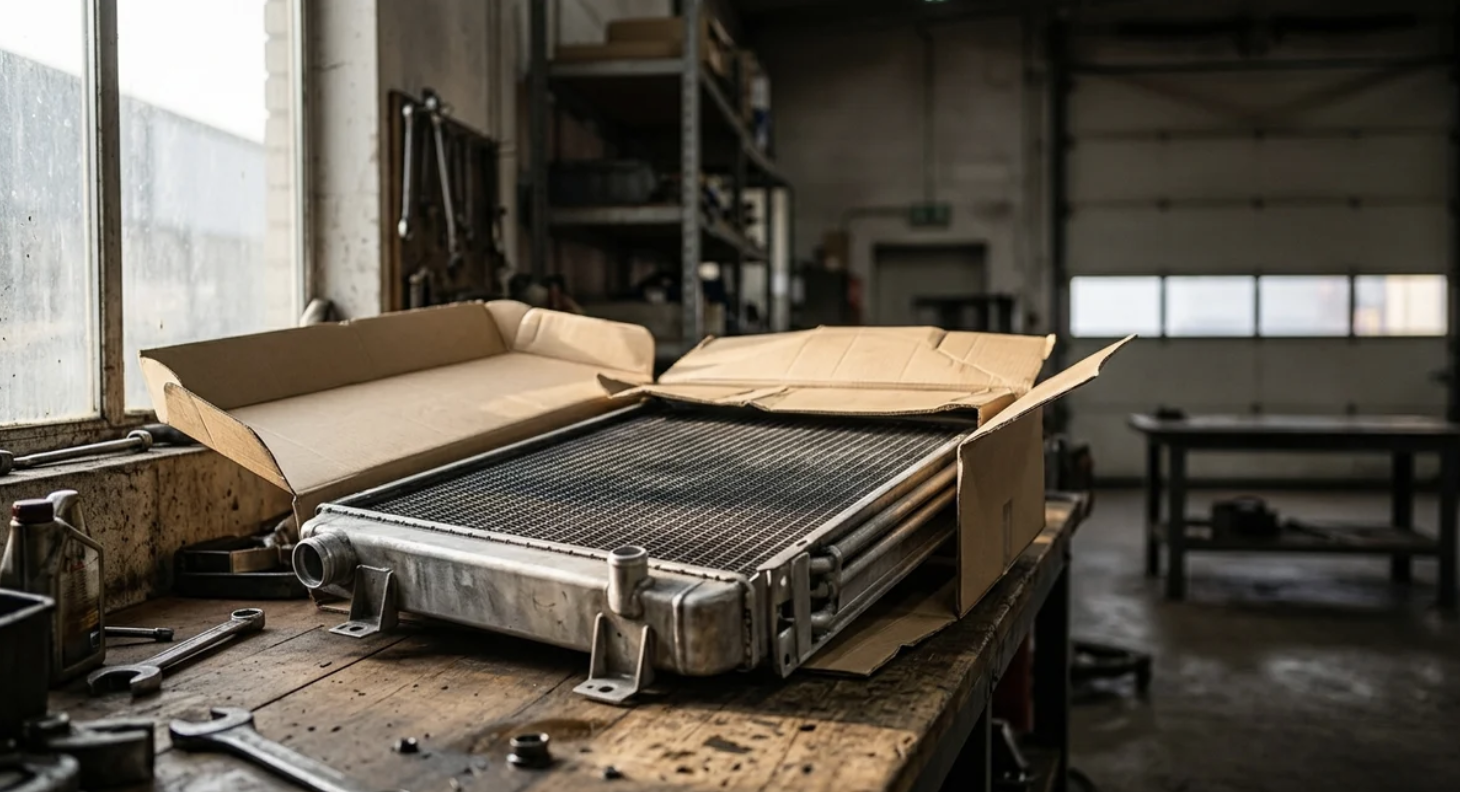
Counterfeit vs Aftermarket Truck Parts: Understanding the Difference
This is where the confusion lives, and it needs clearing up first, because the two terms get used as though they mean the same thing. They do not.
What Genuine Aftermarket Heavy Duty Truck Parts Actually Are
The aftermarket is a legitimate, established industry. It exists because the original manufacturer is not the only company capable of building a radiator, and because a fifteen-year-old truck is not well served by a supply chain that has moved on to newer models. Genuine aftermarket heavy duty truck parts come from real companies with real names on the box, engineered to published specifications, warrantied, and traceable to a manufacturer you can actually contact. Some are built in the same facilities as the parts that went into the truck new. Some are improvements on the original, because the original had a known weak point and somebody fixed it.
What Makes a Part Counterfeit Instead
A counterfeit is not a cheaper alternative. It is a deception, and its defining feature is that it wears another company's name, logo or part number without permission. An aftermarket manufacturer competing under its own name has to stand behind the product, because that name is the only asset it has. A counterfeiter hiding behind somebody else's name has no reason to care whether the part works and no intention of being around when it fails. The line is not OEM versus aftermarket. It is honest versus dishonest.
Why Counterfeit Heavy Duty Truck Parts Are Flooding the Market
A few things happened at once. Parts buying moved online, so a large share of purchasing now goes through marketplaces where the seller is anonymous, and anonymity is exactly what counterfeiting needs. Margins got thinner, so a listing at half price arrives at the worst possible moment for a small operator watching a truck sit idle. And printing and moulding got cheap, so a convincing-looking box costs almost nothing to produce. The gap between how a fake looks and how it performs has never been wider.
Where You Buy Matters More Than What You Pay
Most articles on this subject lead with inspection tips, as though the answer is getting better at spotting fakes once they arrive. Inspection is your last line of defence, not your first. By the time the part is in your hands you have already paid and already lost the days it took to ship.
The real protection is upstream. A supplier worth trusting specializes, so they know their catalogue and know what a part should weigh coming off the shelf. They tell you plainly whether a part is OEM, OEM-equivalent or aftermarket, and vagueness on that question is the single most reliable warning sign in this business. They can answer a technical question about fitment on a specific model year from actual knowledge rather than a copy-paste reply. And they have a returns policy that means something. Suppliers like Quick Fit Parts, which stock heavy duty cooling and AC components as their actual business rather than as one listing among thousands, are the kind of source worth building a relationship with, because a seller who expects to deal with you again next year has a reason to care what goes in the box.
Packaging Red Flags on Counterfeit Truck Parts
The box is the first thing you see, and some signals are worth a second look. Print quality is the most common giveaway: soft or pixelated logos, colours a shade off, artwork that was clearly redrawn from a photo. Text is another, since genuine packaging gets proofread and fakes carry typos and odd grammar. A spelling mistake on a box is not a small detail, it tells you nobody in the chain was accountable for it. Missing information matters too. If the box does not identify the manufacturer or give a real address, that absence is the message. And check that the number on the box matches the number on the part, because counterfeiters print labels far more carefully than they mark components.
Inspecting the Part Itself for Signs of a Fake
Weight, Finish and Material Quality on Truck Radiators
Weight is the quickest test you have. Counterfeits are cheap to produce mostly because there is less material in them: thinner core walls, lighter tanks, thinner gauge throughout. If you have any feel for what a truck radiator should weigh, a fake tends to feel wrong the moment you lift it. Then look at the finish. Real parts come off consistent tooling and look it, with even seams, uniform welds and straight fins. Counterfeits show the shortcuts.
Part Numbers and Manufacturer Markings
Real manufacturers mark parts permanently, stamped, cast or etched into the component rather than applied afterward. A part number on a sticker deserves scepticism. The box, the part and the paperwork should all agree, and where they do not, something in the chain is not what it claims to be.
Fitment Issues That Give a Counterfeit Part Away
Mounting points that do not line up, bracket holes slightly off, fittings a touch wrong in diameter or angle. A counterfeit is usually copied from a sample rather than built from engineering data, and small dimensional errors accumulate. If a part needs forcing, stop. That is not a part that fits, it is a part that is nearly right, which in a cooling system is the same thing as wrong.
Cooling System Parts Where Counterfeits Turn Up Most
Counterfeiters go where the volume is, which means the components replaced most often.
Truck radiators and semi truck radiators are a prime target, because what separates a good one from a bad one is invisible from outside: core construction, tube-to-fin bonding, material thickness. A fake will often cool adequately for a while, then fail, and overheating a heavy duty engine turns a radiator problem into a head gasket problem very quickly.
Charge air coolers are the component people know least about, which makes them easy to fake. The job looks simple but depends on internal geometry and the integrity of every joint under sustained pressure and heat cycling. A counterfeit either leaks quietly, costing boost and fuel economy in a way that gets blamed on something else for weeks, or fails structurally under pressure.
Truck AC compressors cause the most collateral damage. A compressor is a precision assembly, and a counterfeit one is precise only in appearance. When it fails internally it sends debris through the whole refrigerant circuit, so a compressor job becomes a condenser, drier and expansion valve job plus a full flush.
The Real Cost of Installing a Counterfeit Truck Part
Add it up and the arithmetic is not close. You pay for the part, then the labour, then the labour again when it fails early, plus the replacement, plus whatever it damaged on the way out, plus the tow and the downtime. Installing a counterfeit can also compromise warranty coverage on related systems, and a manufacturer investigating a failure will find it. A cheap radiator that voids an engine warranty is an expensive radiator. That forty percent saving worked out, all in, to several times the price of buying the right part from the right place.
Final Word on Protecting Your Fleet
None of this means you should be wary of aftermarket parts. The aftermarket is what keeps working trucks working, and the good manufacturers in it build components equal to anything that came on the truck new.
It means the name on the box is worth very little on its own, and the source is worth a great deal. Know roughly what your parts should weigh and what they should look like, check that the numbers agree, and spend most of your attention on choosing who you buy from. That decision is the one that determines what actually shows up in the box.