
NordVPN's homepage advertises $3.09 a month. Renew that same plan in year three and the bill jumps to roughly $12.99, four times the intro rate. That gap between the teaser price and the renewal price is the first thing that trips people up when they try to figure out how to choose the right VPN service, and it has nothing to do with encryption or server count.
Most comparison articles start with a feature checklist. This one starts with the three variables that actually change what happens to your traffic: who operates the exit server, what jurisdiction that operator answers to, and whether an outside auditor has ever checked the no-logs claim against the actual server configuration rather than just the marketing copy.
What a VPN actually does, and where it stops
A VPN service routes your device's traffic through an encrypted tunnel to a server operated by the provider, then out to the open internet from that server's IP address. Your ISP sees encrypted traffic to one endpoint. The destination website sees the VPN server's IP, not yours.
That's the entire mechanism. It protects one device's traffic on one path at a time. It does not give you ten different exit IPs running in parallel, it does not rotate addresses on a schedule, and it does not let you hold the same residential IP in Warsaw for six months while a different session runs from Dallas. Those are proxy behaviors, and conflating the two is where a lot of buying decisions go wrong.
Real numbers: five providers compared
Pricing below reflects the long-term plan rate as of mid-2026, not the monthly rate most sites lead with. Server counts are self-reported by each provider except where a third-party estimate is noted.
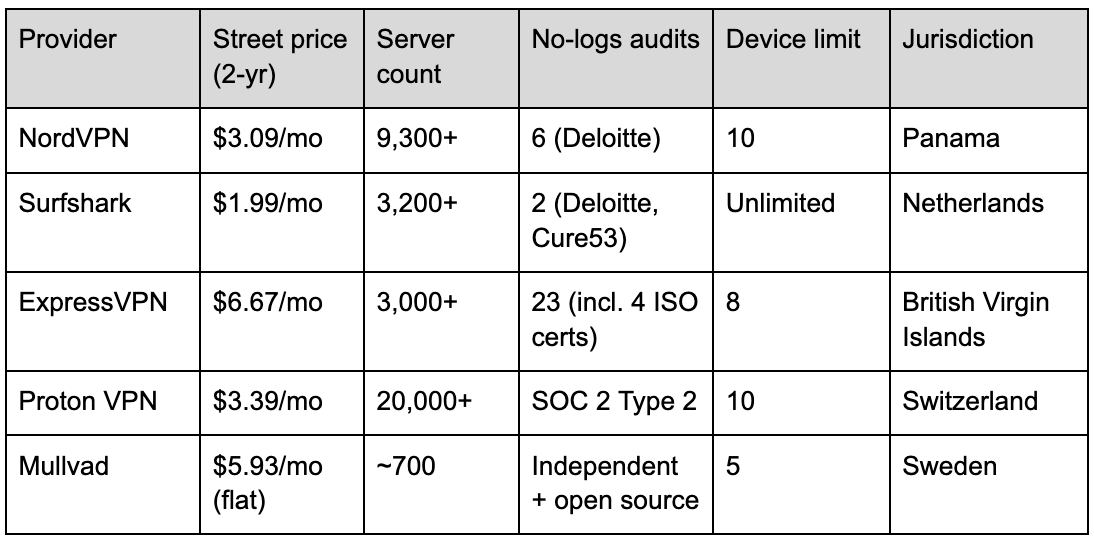
Two things stand out. First, audit depth varies more than marketing suggests: ExpressVPN's 23 audits include four ISO certifications earned in February 2026, while Mullvad has never needed a big audit program because its entire client and server stack is open source and reviewable line by line. Second, jurisdiction matters less than it used to for no-logs claims specifically – Panama, the British Virgin Islands, and Switzerland all sit outside the Five/Nine/Fourteen Eyes intelligence-sharing arrangements, so a provider based in any of them can't be legally compelled the same way a US or UK company can.
The pricing trap, in practice
Surfshark's true annual cost, averaged over three years including the renewal, comes out around $38. ExpressVPN lands closer to $56, and NordVPN around $58, once you stop looking at the first-term number and average across a full renewal cycle. All three publish a monthly figure that looks nothing like what a typical subscriber actually pays.
The workaround people use, cancel before renewal and re-subscribe under a new account, works but adds friction: most providers require a different email address and sometimes a different payment method to unlock the intro rate a second time. A 30-day calendar reminder set at signup is the cheaper habit to build.
Protocol and speed: WireGuard variants dominate
NordLynx (NordVPN's WireGuard implementation) and Lightway (ExpressVPN's proprietary protocol) both post throughput losses under 8% against a raw connection in independent 2026 testing, with NordLynx measured around 4.4% and Lightway in the 10–15% range depending on distance to server. Surfshark's stock WireGuard implementation tracks close behind NordLynx. OpenVPN is still available on most of these services as a fallback, but there's little reason to default to it in 2026 unless a specific firewall is blocking UDP traffic.
RAM-only server architecture is now close to standard rather than a differentiator: Mullvad, ExpressVPN, NordVPN, and Surfshark all run it, and IPVanish is migrating with full completion expected by 2027. RAM-only means a server reboot wipes any data physically, which matters if a data center is ever seized rather than just subpoenaed.
When a VPN isn't the tool you need
A VPN solves the single-tunnel, single-identity problem well. It solves the multi-account, multi-IP, high-volume-request problem badly, because every device connected to the same VPN server shares that server's IP with every other customer on it at that moment. Run automated requests at volume through a shared VPN exit and you inherit whatever reputation that IP already has, good or bad.
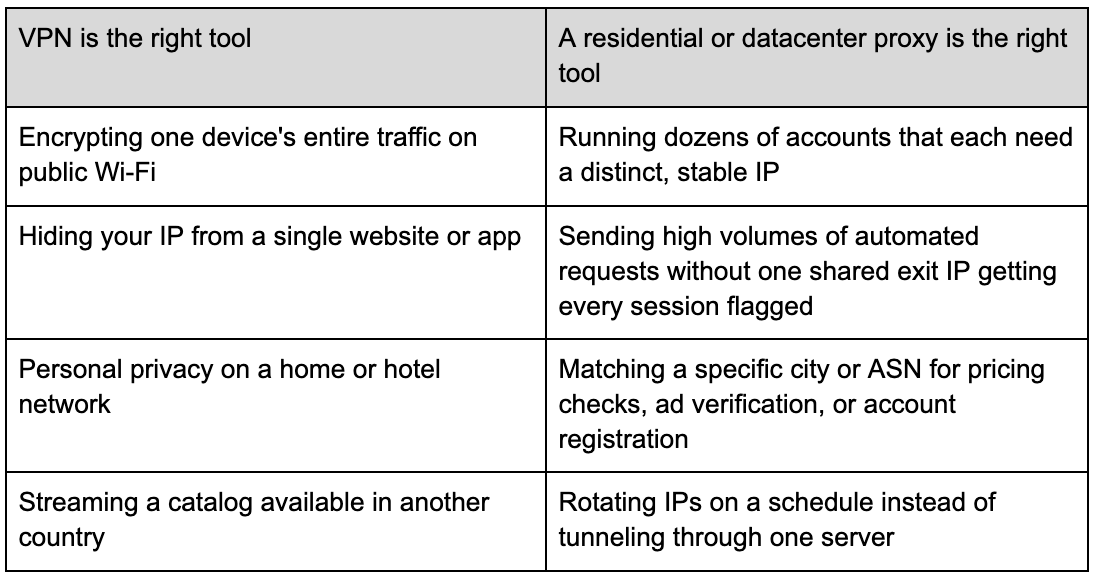
This is the gap that dedicated proxy infrastructure fills instead. Providers such as Proxys.io sell individual and shared IPv4 addresses by location and by protocol (HTTP, HTTPS, SOCKS), starting around $1.40 per IP per month for a dedicated Russian address or $1.47 for foreign locations including the US, Germany, and Poland, with shared IPv4 available from roughly $0.67 when a lower-cost, lower-exclusivity option is enough. The distinction that matters operationally: a proxy gives you a specific, addressable IP you control for the length of your order, rather than a rotating pool shared across a VPN provider's entire customer base at a given moment. For account management, marketplace monitoring, or any workflow where a stable, identifiable IP per session is the requirement rather than traffic encryption, that's a materially different tool than a VPN, and worth pricing out separately before defaulting to whichever VPN plan you already pay for.
A short checklist before you buy
- Does the no-logs claim have an independent audit behind it, dated within the last 18 months, rather than just a policy page?
- What's the renewal price after the intro term, not just the price on the pricing page?
- Does the device limit match how many devices your household or team actually runs, including phones and smart TVs people forget to count?
- Is the kill switch on by default, or does it need to be manually enabled after install?
- Is the refund window long enough to actually test the service on your own network, not just the provider's demo conditions?
Recommendations by use case
For most households juggling streaming, general privacy, and a handful of devices, NordVPN or Surfshark cover the ground at a defensible price once you account for renewal rates. Surfshark's unlimited device count is the deciding factor for larger households; NordVPN's speed and feature depth edge it out for anyone running Meshnet or heavier daily use.
Users whose threat model includes government surveillance or working with sensitive sources are better served by Mullvad or Proton VPN. Mullvad's no-email, cash-payable signup and fully open-source stack remove more trust assumptions than any audit report can. Proton VPN adds a genuinely usable free tier, which matters if the requirement is avoiding a paid account trail entirely.
Frequent travelers to countries that actively block VPN traffic, including extended stays in China, get more practical value from ExpressVPN's Lightway protocol and its track record of staying reachable under network-level blocking, even though it's the most expensive option on this list at full price.
None of these five is wrong for every case. The mismatch happens when someone picks based on a homepage price and finds out eighteen months later what the service actually costs, or picks a VPN to solve a problem that was never about encryption in the first place.