
Are you still waiting hours for a bank transfer to clear before you can start playing? In 2026, players expect instant top-ups, and the payment method you choose determines whether that expectation is met. PaysafeCard sits at a specific point in that landscape — fast, private, and purpose-built for users who do not want to share financial details. But it is not the right fit for everyone.
What Makes PaysafeCard Different From a Bank Transfer
PaysafeCard completes a deposit without requiring any bank account credentials, card numbers or linked financial accounts. A player purchases a voucher, enters a 16-digit PIN, and the funds appear in the account. Bank transfers, by contrast, require manual entry of routing details and typically take one to three business days to process — sometimes longer depending on the issuing bank and jurisdiction.
The difference is not only technical. It is structural. Bank transfers are pull-based: the casino initiates or waits for a transfer through a banking network. PaysafeCard is push-based: the player acts instantly with a prepaid value. According to payment infrastructure analysts who studied European online gaming markets in 2025, prepaid voucher methods consistently show deposit completion rates above 95% within minutes, compared to standard bank transfers where processing delays affect a measurable share of transactions. A blogger who covers payment UX in iGaming noted: “The moment I switched to Casino PaysafeCard for routine top-ups, the friction just disappeared. No bank app, no waiting.”
How Does PaysafeCard Compare to Debit and Credit Card Deposits
Debit and credit card deposits are also fast — often processed within seconds. So the real differentiator between PaysafeCard and card payments is not speed alone. It is privacy and payment separation.
When a player uses a debit or credit card, the card number, expiry date and sometimes billing address are transmitted and stored. With PaysafeCard, none of that happens. The voucher PIN is the only credential involved. For users who compartmentalise their spending or who simply prefer that their bank statement not reflect gaming activity, PaysafeCard offers a structural advantage that no card payment can replicate.
However, cards generally offer higher deposit ceilings. A single PaysafeCard voucher is capped at a fixed denomination — commonly between €10 and €100 — while card deposits typically support 2 or more payment options with higher individual transaction limits. A player whose session funding strategy requires larger single deposits will find card payments more accommodating than voucher-based methods.
Is PaysafeCard or an E-Wallet Faster for Deposits
Both PaysafeCard and e-wallets like Skrill or Neteller process deposits almost instantly. In raw processing time, the difference is negligible — both methods typically complete within seconds to a few minutes. The meaningful distinction lies in setup and ongoing convenience.
Where E-Wallets Have the Advantage
E-wallets store a balance that can be reloaded from multiple sources including bank accounts, cards and even other e-wallets. Once funded, an e-wallet account can be used repeatedly without any additional purchase step. Withdrawals through e-wallets are also widely supported, creating a closed loop for gaming funds. For players who deposit and withdraw frequently, e-wallets reduce friction at both ends of the transaction.
Where PaysafeCard Has the Advantage
PaysafeCard requires no account registration and no personal data submission beyond the PIN. An anonymous player who tested multiple methods at a mid-tier European casino in late 2025 stated: “E-wallets are convenient, but they still link back to my bank. PaysafeCard keeps everything separate.” For privacy-focused users, that separation is worth the extra step of purchasing a voucher. PaysafeCard also eliminates the risk of overspending beyond the voucher value — a fixed denomination enforces a natural deposit boundary that e-wallets do not provide.
Which Deposit Method Is Right for Different Player Types
No single method is universally superior. The best deposit option depends directly on what a player prioritises. Here is a structured comparison to clarify where each method leads:
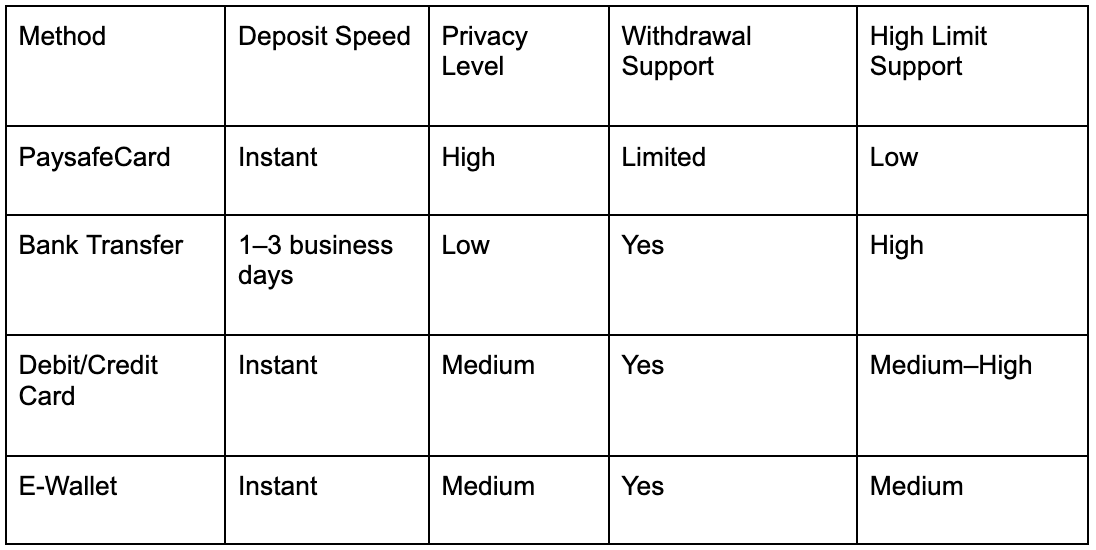
The table reflects the general attribute landscape across deposit methods available in 2026. PaysafeCard leads on privacy and offers fast deposit time, but its disadvantage of cash voucher funding — fixed denominations and no withdrawal path — makes it a deposit-only tool rather than a full payment solution.
When Should You Choose PaysafeCard Over Other Options
PaysafeCard is the better choice when privacy is the primary concern and deposit amounts align with standard voucher denominations. Players who want instant deposit time without exposing banking credentials, who fund accounts in controlled increments and who do not require the same method for withdrawals will find PaysafeCard fits their workflow precisely. In 2026, with instant top-up expectations now standard across the industry, PaysafeCard meets the speed benchmark — it simply does so with a narrower feature set than e-wallets or cards.
Choose PaysafeCard when speed and privacy matter more than flexibility — and use a card or e-wallet when high limits or withdrawal symmetry are required.