

Image by Bennett Shaw
I remember exactly where I was during the ad blitz. Spring of 2022, Leafs and Lightning, and every single commercial break felt like it had been bought by the same four companies. Ontario's open market went live on 4 April 2022, and within about a fortnight you could not watch a period of hockey, listen to a sports radio hit, or scroll a Toronto Twitter feed without somebody in a suit telling you the odds on the next goal scorer. It was not subtle. It was not meant to be subtle. It was a land grab, and the medium of record for that land grab was Toronto media.
Alberta opened its own private online market on 13 July 2026, second province in the country to do it, and the whole thing is structured to mirror what Ontario built. The Alberta iGaming Corporation holds the commercial agreements, AGLC regulates, and around 50 operators had completed registration with 20 or so live on day one, competing against the government-run PlayAlberta that was already there. BetMGM is among the brands reported at launch, which is why Lineups' rundown of the betmgm sportsbook alberta offer is a more useful thing to read than any of the creative that is about to blanket Edmonton drive time, because it describes what the product actually is rather than how it feels in a thirty second spot.
I am not writing this as a betting guy. I am writing it as somebody who has watched Toronto's media economy up close for two decades, who has sold ads, who has been on the receiving end of programmatic inventory, and who watched an entire category arrive, saturate, overreach, and then get legislated back into its box. Alberta is now on day one of that same cycle. Toronto has already read the script.
Phase one is always buy everything
The first thing that happens after a market opens is not clever marketing. It is volume. Operators launching into an open market are not trying to win an argument, they are trying to buy name recognition before the other nineteen brands do, because in a market where every book takes the same bet on the same game, the only real product differentiator early on is whether the customer has heard of you.
In Ontario that meant television, radio, transit, arena boards, podcast reads, and every square inch of digital inventory that pointed at a Canadian IP address. It meant the same handful of jingles played so often that people who have never placed a bet in their lives can still recite them. And it meant the sports broadcasters, who had spent a decade watching auto and telecom money get squeezed, suddenly had a category bidding aggressively against itself.
Alberta's version will be smaller in absolute dollars, because Alberta has roughly a third of Ontario's population, but proportionally it will feel identical. Watch Oilers broadcasts. Watch Flames broadcasts. Watch the Edmonton and Calgary sports radio breaks. That is where phase one lives.
The celebrity problem, and how Ontario legislated its way out of it
Here is the part Toronto lived through that Alberta has not yet.
Ontario's early ad wave leaned hard on famous faces. Retired hockey players. Active athletes. Actors. The complaint was not that adults were seeing gambling ads, it was that ten year olds watching a hockey game were seeing their favourite player, or a guy their dad has a jersey of, telling them about parlays. That is a very hard thing to defend at a school board meeting.
The AGCO moved. It announced in August 2023 that it would prohibit athletes, active or retired, from appearing in Ontario igaming advertising, along with celebrities, influencers, entertainers and cartoon figures likely to appeal to minors. The one carve out was responsible gambling messaging. Those amended standards took effect on 28 February 2024, and if you were paying attention to Toronto broadcasts you could feel the change inside a month. The famous faces vanished. The creative got noticeably duller, and considerably more about the app interface and the promotional terms.
That is the single most instructive thing Ontario has to hand Alberta, and it is worth being honest about the sequencing. Ontario did not launch with those rules. Ontario launched, got two years of saturation, absorbed the public reaction, and then wrote the rules. Whether Alberta compresses that timeline, arrives with tighter expectations from the start, or repeats the full arc is the open question of the next eighteen months, and I would not bet on any of the three.
Where Alberta sits on the Ontario clock
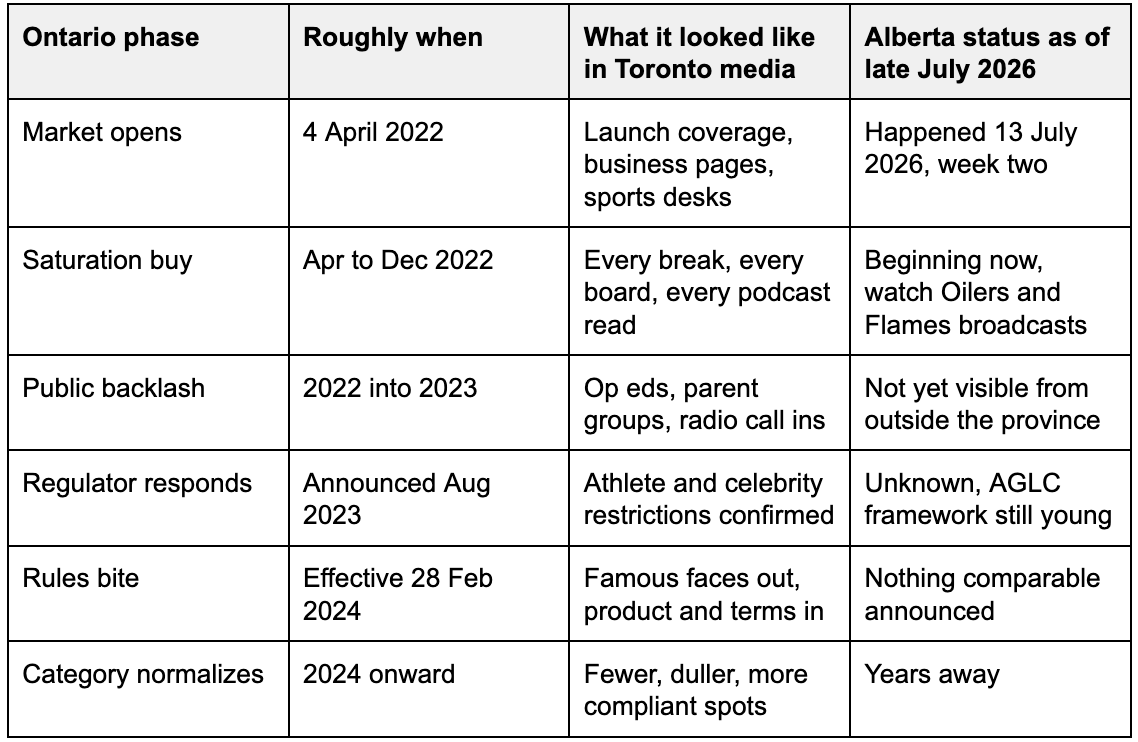
The right way to read that table is as a rhythm, not a prophecy. Alberta could skip a step. Alberta is 18+ where Ontario is 19+, which changes the youth exposure conversation in ways I do not think anyone has fully worked through yet. But the shape of the cycle, land grab then backlash then rules then boredom, is not unique to gambling. It is what happened with payday loans, with vaping, and with crypto exchanges. Gambling just moved through it in front of a hockey audience, which made it loud.
The part nobody warns small publishers about
There is a version of this story that only independent publishers notice, and it is the one I actually want to flag.
When a new category floods the market, most of that money does not arrive as a nice clean sponsorship conversation with a human being. It arrives programmatically. It gets stuffed into ad exchanges and served into podcast feeds and blog sidebars by an ad server that does not know or care what show it landed on. Mike wrote a whole post about how to listen to Toronto Mike'd without programmatic ads, which is a Patreon perk on this end but also a quiet admission of something every independent operator understands: you do not fully control what the exchange decides to put in your feed.
That is not a scandal, it is just how the plumbing works. But it means that when Alberta's ad money hits the exchanges, Alberta podcasts, Alberta newsletters and Alberta community sites are going to find gambling creative in their inventory whether or not they went looking for the category. Ontario publishers learned this in 2022. Some took the money happily. Some blocked the category outright. Some discovered they had been serving it for months without noticing. Alberta's independents get to make that decision now, ideally on purpose rather than by accident.
Why the money matters more than it used to
The commercial backdrop is different this time, and it is worth saying out loud.
Canadian radio is contracting. Rogers announced this month that it is shuttering six stations, which anybody who follows Toronto media clocked immediately as the confirmation of a decade long trend rather than a surprise. Local broadcast has fewer national categories bidding for it than it had in 2015. So when a category shows up with a launch budget and a two year window in which brand awareness is the entire game, it does not land in a healthy market. It lands in a hungry one.
That matters because a hungry medium is a compliant medium. It asks fewer questions about frequency caps, about placement next to youth-adjacent programming, about whether four gambling spots in one break is a good look. Ontario broadcasters were not villains about this, they were just not incentivized to be picky. Alberta broadcasters will be in the same position, only more so.
What BetMGM specifically tells you
Of the brands in this market, BetMGM is the one I find most legible, because its Ontario entry was so heavily built on brand borrowing. It is a joint venture attached to a casino name people already know from Las Vegas, and its Ontario campaign leaned on that recognition rather than on trying to explain online sports betting from scratch.
Alberta gets a version of that same approach, refined by four years of Ontario data about which messages survive contact with a regulator. So the interesting question is not whether BetMGM shows up loudly in Alberta. It will. The interesting question is whether the Alberta creative already looks like post-February-2024 Ontario creative, meaning product features and promotional terms rather than famous faces. If it does, that tells you the operators have internalized the rules and are not waiting to be told. If it does not, and Alberta gets a 2022 style celebrity wave, then Alberta is going to have the 2023 style argument, and it will get there faster because Ontario already ran the experiment.
Either way, the ads are not where the useful information is. The terms are. Playthrough requirements, expiry windows, maximum win caps and what actually counts as a qualifying bet are the things that decide whether an offer is worth anything, and none of that fits in a thirty second spot. Odds imply probability, not certainty, favourites lose regularly, and the house edge does not take a launch week off.
What I will be watching from here
A few concrete markers, for anyone who wants to follow this the way a media person would rather than the way a bettor would.
Frequency first. Count the gambling spots in a single Oilers broadcast in October, when the season is properly underway and the launch novelty has worn off. If the count is still climbing, phase one is not over.
Faces second. Note whether any recognizable Alberta sports figure appears in operator creative. That is the tripwire. In Ontario, that was the thing that produced the rule.
Local buys third. Watch whether the money reaches Alberta's independent media, the community podcasts and the small sites, or whether it all stays inside national broadcast. In Ontario it eventually reached everybody, which is how a lot of publishers ended up making a category decision they had not planned to make.
And fourth, watch the tone of the coverage. Toronto's gambling coverage went from business-page novelty to sports-page fixture to public-health story in about twenty months. Alberta's is currently at stage one.
Frequently asked questions
Is this legal in Alberta now, or is it still a grey market?
It is a regulated market as of 13 July 2026. The iGaming Alberta Act received Royal Assent on 15 May 2025, the Alberta iGaming Corporation holds the commercial agreements with operators, and AGLC handles regulation. That is the same conduct-and-manage split Ontario uses, and it replaced a situation where offshore sites operated without provincial oversight.
Why do Ontario ads look different from the ones I saw in 2022?
Because the AGCO changed the rules. The regulator's announcement that it would ban athletes from Ontario igaming advertising to protect minors covers athletes active or retired, except when they are advocating for responsible gambling, and extends the restriction to celebrities and influencers likely to appeal to minors. That took effect on 28 February 2024, which is why the creative shifted toward app features and promotional terms, all of it running under Ontario's internet gaming standards.
Does Alberta have the same advertising restrictions?
Not identically, and I would not assume it does. Alberta's framework is new and its advertising standards are their own document. Alberta is also 18+ where Ontario is 19+, which is a meaningfully different starting point for any conversation about youth exposure. If you are in Alberta, read AGLC's own material rather than assuming Ontario's rules travelled west.
Should independent podcasters and bloggers block the category?
That is a business decision, not a moral one, and reasonable people land in different places. What I would say is make the decision deliberately. If you run programmatic inventory, the category can appear in your feed without a conversation ever happening, so check your exchange settings before the money arrives rather than after a listener emails you about it.
Is any of this a reason to start betting?
No, and nothing here should be read that way. This is a piece about how an advertising category behaves when a market opens. Betting is entertainment with a built-in house edge, the ads are designed to make it feel otherwise, and if it stops being fun the responsible gambling resources exist for a reason. In Alberta the legal age is 18, in Ontario it is 19, and GameSense and AGLC's support material are the starting points if you or somebody in your house needs them.
The short version
Toronto watched this movie in 2022. The ad wave, the famous faces, the backlash, the rules, and then the strange quiet afterwards when the category settled into being just another advertiser. Alberta is at the opening credits. The only real advantage Albertans have is that the ending is already on the record, and if enough people in Edmonton and Calgary have read it, the middle part might be shorter this time.