
The most important sports betting development in Ontario this year was not another flashy app, oversized parlay promotion or celebrity endorsement. In May 2026, the province launched BetGuard, a single system that lets adults exclude themselves from every regulated online gambling platform in Ontario. That development says something important about sports betting bankroll management: setting limits matters more than finding more action.
Toronto sports fans know how quickly emotion can take over. The Leafs surrender a late lead, a Blue Jays reliever ruins a run-line bet, or the final leg of a Raptors player-prop parlay misses by one rebound. Suddenly, the next wager is twice as large because it is supposed to recover the first loss.
For readers assessing promotional value alongside a separate betting budget, Fair Gambling offers a Rainbet weekly bonus calculator estimate and comparisons of ongoing reward components. The result is a planning estimate, not guaranteed cash, so eligibility, release timing and current terms still need to be checked before any reward is counted.
That distinction captures the purpose of bankroll management. It does not predict winners, remove risk or transform recreational betting into dependable income. It creates boundaries around how much money is available, how much can be staked on one selection and when betting should stop.
The system is not exciting. It will never provide the rush of a five-leg parlay hitting in overtime. What it can do is prevent one emotional evening from consuming money that was intended to last through an entire season.
What a Sports Betting Bankroll Really Is
A sports betting bankroll is money reserved exclusively for wagering.
It should not include rent, groceries, transport costs, debt payments, emergency savings or money borrowed from another person. Losing the entire bankroll should not interfere with essential expenses or create pressure to win the money back.
That separation sounds obvious, but sportsbook balances can blur the picture. Seeing C$600 in an account does not necessarily mean C$600 is available to bet. The balance may include:
- Cash deposits
- Withdrawable winnings
- Unsettled stakes
- Promotional credit
- Pending rewards
- Funds subject to wagering conditions
A proper betting bank should meet three basic tests.
First, the money is genuinely disposable. Second, it was set aside before any wagers were selected. Third, the bettor is prepared to stop when it is gone.
It helps to think of wagering as paid entertainment. Someone might reserve money for concerts, restaurants, hockey tickets or a weekend trip. Betting funds belong in that same category, except their value will move up and down as wagers settle.
The goal is not to make losses painless. It is to ensure that losses remain inside a boundary established before frustration, excitement or urgency affects the decision.
Why Bankroll Management Matters in Ontario Now
Sports betting has become part of the everyday sports conversation in Toronto. Odds appear during broadcasts, betting markets are discussed on podcasts, and group chats can move from lineup news to parlays in seconds.
Easy access creates a practical problem. Bettors no longer need to make a special trip or wait for the weekend. A new wager can be placed immediately after a loss, often from the same screen showing the disappointing result.
That speed makes predetermined limits more important.
Bankroll management inserts a pause between feeling and action. Instead of asking, “How much do I need to win back?” the bettor asks, “What does my staking plan allow?”
The answer will sometimes be a small wager. It will often be no wager at all.
Good money management also makes results easier to evaluate. When bet sizes change constantly, it becomes difficult to tell whether the underlying predictions were useful or whether one oversized win is hiding a long run of bad bets.
Consistent stakes produce cleaner information. Cleaner information supports better decisions.
How to Set a Starting Bankroll You Can Afford to Lose
There is no universally correct starting bankroll for sports betting.
C$100 may be reasonable for one person and completely inappropriate for another. Income, debt, savings targets, family commitments and betting frequency matter more than an arbitrary minimum.
Begin by choosing a fixed amount of disposable entertainment money for a defined period. The period might be one month, the baseball season or the remainder of the hockey calendar.
Do not automatically refill the account when the original bankroll has been lost. An immediate reload defeats the purpose of setting a limit.
The most useful question is not “How much can I deposit?” It is “How much am I prepared to lose without changing any other part of my life?”
A bettor who expects to make one or two wagers each weekend may need a different structure from someone betting several sports every day. More bets mean more total exposure, even when the stake on each selection appears small.
The following examples show how different percentages affect common starting bankrolls.
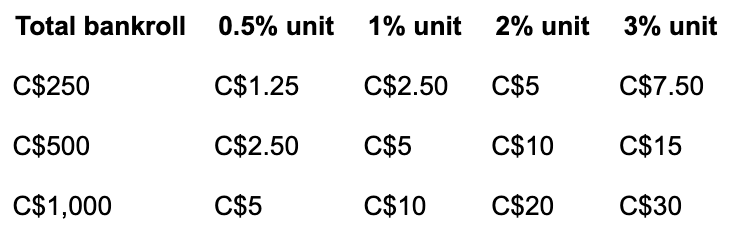
A larger bankroll does not indicate greater skill. It only changes the cash value of each unit.
Small stakes can feel slow, especially during a winning streak. Speed, however, is not the objective. The objective is to remain within your means when results become unpredictable.
How Many Units Should Your Bankroll Have
A unit is a standard measurement used to describe bet size.
If a C$500 bankroll contains 100 units, one unit equals C$5. A standard one-unit bet therefore risks one percent of the starting bankroll.
Using 100 units is a simple framework for many recreational bettors. It does not make the wager itself safer, but it limits the damage one result can do to the overall bankroll.
More cautious bettors may use 200 units, making each standard bet 0.5 percent. This can be appropriate for people placing several bets a day or using higher-variance markets such as long-priced player props and parlays.
At the other end, a bettor using 20 units risks five percent of the total bankroll on every standard wager. Ten flat losses would remove half of the original funds.
That drawdown matters because percentage losses and recoveries are not symmetrical.
A bankroll that falls by ten percent needs an 11.1 percent gain to recover. A bankroll that falls by 50 percent must then grow by 100 percent to return to its starting point.
This is why risking too much per bet can be difficult to overcome.
A unit should not become larger because a bettor feels unusually confident about a televised game. Confidence is not evidence of an edge. It is often influenced by team loyalty, recent results or how strongly someone wants to have action.
Unit size should also not be recalculated after every win or loss. Constant adjustments can disguise emotional betting. A cleaner approach is to review the bankroll after a scheduled number of wagers, such as 50 or 100, or at the end of each month.
Three Ways to Determine Your Bet Size
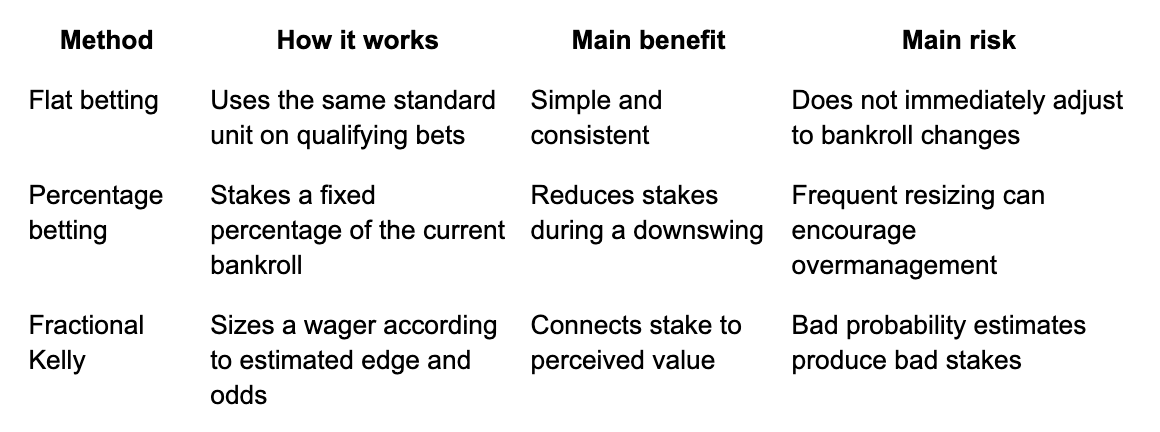
The most common bankroll management strategies are flat betting, percentage betting and the Kelly Criterion.
Flat Betting
Flat betting means using the same unit size on most qualifying selections.
A bettor with a C$500 bankroll and a C$5 unit might place one unit on each standard single bet. This approach is straightforward, easy to track and difficult to manipulate after a frustrating loss.
Flat betting does not require every possible market to receive an identical amount. A bettor could establish in advance that ordinary single bets receive one unit while parlays and long-odds props receive no more than a quarter-unit.
The rules must be created before the individual selection is made.
Someone who regularly labels picks as three-unit, five-unit or “maximum confidence” plays is no longer following a genuine flat betting system. Emotional confidence has replaced consistent risk management.
Percentage Betting
Percentage betting sizes each stake relative to the current bankroll.
With a one-percent rule, a C$600 bankroll produces a C$6 standard wager. If the bankroll drops to C$450, the next stake becomes C$4.50.
The advantage is that exposure automatically falls during a losing period. Stakes can also increase gradually if the bankroll grows.
The disadvantage is that bettors may become preoccupied with every small balance change. They may also update the calculation after wins while conveniently ignoring it after losses.
A practical compromise is to resize at scheduled checkpoints. Calculate a unit for the next 25 or 50 wagers, use it consistently, and review it only when the block is complete.
The Kelly Criterion
The Kelly Criterion calculates a theoretically optimal stake using the available odds and the bettor’s estimated probability of winning.
For decimal odds, the formula can be written as:
Kelly fraction = decimal odds × estimated win probability − 1 ÷ decimal odds − 1
The calculation must be read as:
Kelly fraction = (decimal odds × estimated win probability − 1) ÷ (decimal odds − 1)
Suppose a bet is offered at decimal odds of 2.00 and the bettor believes it has a 55 percent chance of winning.
The full Kelly calculation is:
(2.00 × 0.55 − 1) ÷ (2.00 − 1) = 0.10
That produces a full Kelly stake of ten percent of the bankroll.
The result illustrates the method’s biggest danger. If the estimated 55 percent probability is overly optimistic, the recommended bet size becomes far too large. The formula cannot identify a poor assumption. It simply processes the number supplied by the bettor.
Full Kelly can also create substantial swings. Advanced users may apply half Kelly or quarter Kelly, risking only part of the recommended amount.
For most recreational bettors, a small flat unit is easier to understand and less vulnerable to false confidence.
A Simple Bankroll Management System
A betting system should remain easy to follow after a bad beat. Complicated rules have a habit of disappearing when the bettor is angry or excited.
A practical system can be built around seven steps.
- Set the total bankroll
Use only money that can be lost without affecting essential expenses. - Choose one standard unit
One percent of the starting bankroll is a straightforward reference point. A more cautious bettor may use 0.5 percent. - Establish a daily exposure limit
A series of small bets can still create a large risk. Consider limiting all open stakes to three or five percent of the total bankroll. - Create rules for volatile bets
Parlays, long odds and certain player props may justify smaller stakes than standard single bets. - Record every wager
Include wins, losses, pushes, free bets, promotional wagers and impulsive selections. - Review a meaningful sample
Do not rebuild the strategy because of three wins or three losses. Look for patterns over a larger number of wagers. - Use predetermined stopping points
Stop when the daily exposure ceiling is reached, the planned session ends or decisions begin to feel emotional.
These rules control risk. They do not create positive expected value or improve the underlying prediction.
How to Separate Variance From Bad Predictions
A losing streak does not automatically mean the analysis was poor. A winning streak does not prove that the strategy is profitable.
Variance describes the natural movement of results around their expected outcome. A well-researched bet can lose because of an injury, a disputed call, an empty-net goal or an unusually poor performance.
A weak bet can also win because of a lucky bounce.
That is why every bet should be reviewed by more than its final result.
Ask whether the price was competitive. Check whether important information was missed. Decide whether the original reasoning was logical and repeatable. Compare the odds taken with the closing price where that information is available.
Results should also be divided by sport, league and market.
Someone may perform reasonably on NHL moneylines while consistently losing on NBA player props. Another bettor may show a small profit on single bets but return all of it through parlays.
This analysis helps separate normal variance from a genuine problem.
A poor response to variance is increasing the stake to recover more quickly. A larger wager does not correct an earlier result. It only puts a larger share of the remaining bankroll at risk.
The better response is to pause, review the data and decide whether the issue is bad luck, bad pricing, weak predictions or too many unnecessary wagers.
How Tracking Bets Improves Bankroll Decisions
Tracking converts impressions into evidence.
Without a written record, dramatic wins tend to remain more memorable than routine losses. A five-leg parlay that hits may be discussed for months, while the unsuccessful parlays placed before and after it disappear from memory.
A basic spreadsheet can prevent that distortion.
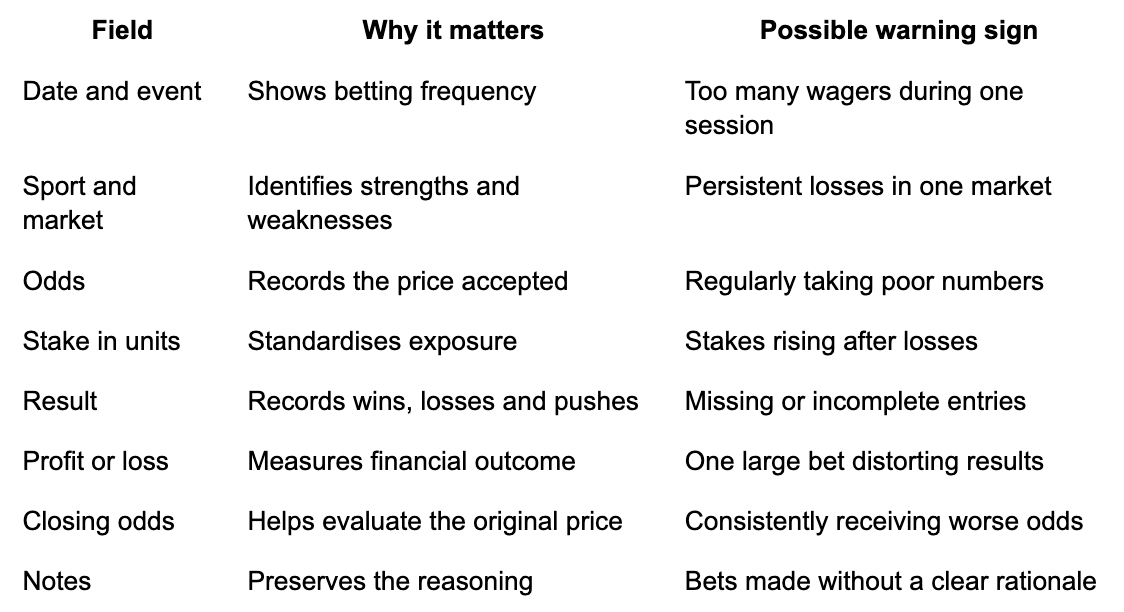
Two measurements deserve particular attention.
Units won or lost express results relative to standard bet size. This makes comparisons easier when the cash value of a unit changes.
Return on investment compares net profit with the total amount wagered.
The formula is:
ROI = net profit ÷ total amount wagered × 100
Suppose someone stakes a combined C$5,000 and finishes C$150 ahead. The ROI is three percent.
Is three percent a good ROI? It may be encouraging, but the sample matters. A three-percent return after 20 bets reveals very little. The same result over hundreds of accurately recorded wagers is more informative, although it still does not guarantee future success.
ROI should also be considered alongside odds, market type, turnover and maximum drawdown.
Someone who wins C$100 after risking C$10,000 has achieved a different result from someone who wins C$100 after risking C$1,000.
Common Ways Bettors Damage Their Bankroll
Most serious bankroll mistakes are behavioural rather than mathematical.
Chasing losses means increasing the next bet because the previous one lost. The new selection is expected to repair an old result, even though the events may be unrelated.
Increasing stakes during a winning streak can be equally dangerous. Recent wins may reflect variance rather than improved predictive skill.
Treating parlays like single bets exposes too much money to a lower-probability outcome. Parlays may be entertaining, but entertainment value does not justify a larger stake.
Betting every televised game turns availability into a betting strategy. There is no obligation to have action on the late game because an earlier wager lost.
Copying an unverified handicapper transfers the decision without transferring accountability. Public records may use unavailable odds, omit unsuccessful picks or highlight only profitable periods.
Ignoring the price is another common error. Predicting the winning side is not enough. The odds determine how often the wager must win to break even.
Resetting records after a bad month removes the evidence needed to improve. Moving money to another sportsbook does not erase the loss from the overall betting bank.
Using borrowed money creates repayment pressure and can make disciplined decisions much harder.
The clearest sign of sound bankroll management is often the ability to pass on a bet.
Why Bonuses Are Not the Same as Bankroll
Weekly rewards, rakeback, free bets and other promotions may have value, but they should not automatically be added to a cash bankroll.
A reward may depend on:
- VIP level
- Eligible games or markets
- Wagering volume
- Profit or loss during a defined period
- Claim deadlines
- Account verification
- Regional availability
- Withdrawal conditions
FairGambling’s current calculator lists Rainbet reward components including instant rakeback, daily, weekly, monthly and pre-monthly bonuses. It also identifies matters that need checking, such as Bronze-level unlock requirements, release timing and pre-monthly eligibility.
For a more realistic comparison, Fairgambling lets readers test consistent wagering inputs across different reward structures instead of judging an offer by its headline figure alone. Run both profit and loss scenarios, then confirm the live terms before making a deposit or changing a betting budget.
A sensible record separates cash and promotional value into different categories:
- Deposited cash
- Withdrawable winnings
- Unsettled stakes
- Promotional credit
- Pending rewards
- Withdrawable bonus proceeds
This prevents a bettor from staking money that is not actually available.
A calculator does not turn a projected reward into guaranteed cash. Promotions should also never become a reason to wager more than planned. A useful test is simple: would the bet still be placed without the promotion?
How Ontario’s New BetGuard Tool Changes the Safety Net
Bankroll limits can create boundaries, but they cannot prevent or treat problem gambling.
A person can use one-percent units and still gamble too often, conceal activity from family members or spend excessive time monitoring markets.
Ontario’s newly launched BetGuard system provides a stronger stopping option. Adults can use one portal to exclude themselves from all regulated online gambling platforms in the province, including OLG’s online products. Available exclusion periods include six months, one year, five years or a custom term. The system also prevents participating operators from sending direct marketing during the exclusion.
That is more meaningful than simply uninstalling one sportsbook app while keeping several others active.
Warning signs that require more than a new staking plan include:
- Spending more time or money than intended
- Chasing losses
- Borrowing to gamble
- Hiding activity
- Feeling unable to stop
- Using betting to escape stress
- Continuing despite harm to finances or relationships
Ontario residents can also contact ConnexOntario for free, confidential support at 1-866-531-2600 or text connex to 247247. Trained specialists are available around the clock, and no referral is required.
When those warning signs appear, the priority is not finding a more advanced betting system. It is reducing access, taking a break and seeking support.
What Sports Bettors Should Remember
Proper bankroll management is less about discovering a perfect percentage and more about making consistent decisions.
Keep betting funds separate from essential money. Use a unit small enough to withstand ordinary losing streaks. Record every wager, including the ones you would rather forget. Review performance by sport and market instead of judging the strategy by last night’s score.
Do not assume that discipline creates an edge. Bankroll management can limit individual mistakes and help betting funds last longer, but it cannot make an overpriced wager profitable.
Toronto’s sports calendar will continue to produce another game, another market and another opportunity. There is no need to force a bet tonight, chase a late result or risk the entire bankroll on one confident prediction.
Sometimes the strongest bankroll decision is closing the app and watching the game.
Frequently Asked Questions
What is a sports betting bankroll and why is it important?
A sports betting bankroll is money reserved exclusively for wagering. It separates betting funds from essential expenses and places a clear limit on the total amount available to lose.
What is a good starting bankroll for sports betting?
There is no universal amount. A suitable starting bankroll is disposable entertainment money that can be lost without affecting bills, savings, debt payments or other responsibilities.
How do you manage your bankroll in sports betting?
Set a fixed total bankroll, choose a small standard unit, limit daily exposure, track every wager and review results only after a meaningful sample. Never increase a stake simply to recover a previous loss.
How many units should you have in your sports betting bankroll?
A 100-unit structure is a straightforward starting framework for many recreational bettors. One unit then represents one percent of the bankroll. More cautious bettors may use 200 units.
How do you determine your unit size for sports betting?
Multiply the total bankroll by the chosen percentage. A C$500 bankroll using a one-percent unit produces a C$5 standard bet.
What is the Kelly Criterion in sports betting bankroll management?
The Kelly Criterion is a formula that connects bet size to available odds and an estimated probability of winning. Because inaccurate probability estimates can produce oversized wagers, some advanced users apply only half or one-quarter of the full Kelly recommendation.
What is the 80 20 rule in sports betting?
The phrase has no single accepted meaning in sports betting. It may refer to concentrating most wagers on a bettor’s strongest markets or reserving only a small share of the bankroll for speculative bets. Clear unit and exposure limits are more useful than relying on an undefined 80 20 rule.
Is a three-percent ROI good in sports betting?
A three-percent ROI may be positive, but it needs context. The number is more meaningful when it comes from a large, accurately recorded sample than from a short winning streak.
How can tracking your bets help with bankroll management?
Tracking reveals betting frequency, stake changes, weak markets, total exposure and actual ROI. It also makes it harder to remember wins while overlooking losses.
Can bankroll management help with problem gambling?
Bankroll management can establish financial boundaries, but it cannot diagnose, prevent or treat problem gambling. Anyone chasing losses, borrowing money, hiding betting or struggling to stop should take a break and contact a qualified support service.