
Digital entertainment plays a central role in daily life across Canada. High-speed internet access, widespread smartphone use, and long winter seasons encourage people to spend significant time online. Streaming video, online games, social platforms, and interactive services all compete for attention. Canadians rarely choose digital entertainment at random. They look for specific features that match their expectations for comfort, safety, and engagement.
Research on media behavior in Canada shows that users value convenience, clear design, and fair rules. Many users also expect platforms to respect privacy and avoid aggressive advertising tactics. When people explore entertainment options online, they often evaluate several elements before they decide whether to stay.
Access to Structured Online Gaming Information
Some readers who explore online entertainment also look for clear explanations about gaming platforms and casino activities. Informational hubs help users understand rules, formats, and general platform structure before they decide whether to participate. One example is https://thepiperspin.com, which presents organized material about online casino environments and related entertainment formats.
Many Canadian users prefer to review information before interacting with any gaming service. They examine how games function, how platforms structure their interfaces, and what features shape the overall experience. Informational resources simplify this process by gathering relevant details in one place.
Several aspects often attract readers to structured gaming information platforms:
- Clear descriptions of different casino game categories
- Explanations of rules and scoring systems
- Guides that outline how digital gaming environments operate
- Articles that discuss responsible play and limits
These elements help readers understand the mechanics behind casino entertainment. Instead of exploring multiple scattered sources, users can review organized material that summarizes key points in a direct format.
Clear access and fast performance
Many Canadians live in urban areas with strong internet connections. Rural regions still face slower speeds, yet mobile coverage expands every year. As a result, users across the country expect quick loading times and stable performance.
Platforms that fail to deliver consistent speed often lose visitors within seconds. People rarely tolerate long waits or technical errors.
Several technical features shape user satisfaction:
- Fast page loading on both mobile devices and desktop computers
- Stable video streaming without frequent interruptions
- Clear navigation that allows quick movement between sections
- Interfaces that adjust correctly to different screen sizes
Many Canadians also value platforms that minimize unnecessary scripts or heavy design elements. When a site focuses on usability rather than visual overload, users spend more time exploring content.
A wide selection of entertainment formats
Online entertainment no longer fits into a single category. Canadian users move freely between different formats during the same session. A person might watch a short video, read an article, then open an interactive game.
Modern platforms often combine several types of content:
- Streaming video or live broadcasts
- Online games with simple mechanics
- Interactive quizzes or community challenges
- Long-form articles or analysis
- Discussion spaces or comment sections
This mix keeps attention active. When a site presents only one format, users often switch to another service within minutes.
Entertainment sites also experiment with features that allow quick participation. Polls, comment reactions, and small interactive elements encourage users to stay longer and return later.
Balanced entertainment and responsible gaming
Online gaming occupies a visible role in Canada’s digital culture. Sports predictions, card games, and casino-style activities attract a large audience. However, Canadian users often express strong expectations regarding fairness and transparency.
Players usually examine rules carefully before they participate. They also look for clear explanations about how each game works.
Common expectations include:
- Transparent payout structures
- Clear rules that explain scoring and game mechanics
- Visible information about limits and responsible gaming tools
- Support sections that answer common questions
Users often approach these platforms with curiosity rather than blind trust. They compare features, check policies, and read explanations before they make decisions.
Mobile-first entertainment habits
Smartphones shape how Canadians access digital entertainment. Many people check content during short breaks, commuting time, or quiet evenings at home. Because of this behavior, mobile design affects user satisfaction more than desktop design in many cases.
Developers therefore focus strongly on mobile usability. Canadian users expect interfaces that respond quickly to touch commands and display text clearly on smaller screens.
Important mobile features include:
- Simple menus that allow one-hand navigation
- Large buttons and readable fonts
- Quick switching between sections
- Smooth scrolling without sudden jumps
People often abandon a platform immediately when mobile pages feel cluttered or slow. This reaction appears across all age groups.
Respect for privacy and data control
Privacy concerns continue to shape digital behavior in Canada. Many users feel cautious about how websites collect and store personal data. News reports about data breaches have increased awareness in recent years.
Because of this awareness, Canadians tend to evaluate privacy policies more carefully than before. They often expect platforms to explain clearly what data they collect and why they need it.
Several privacy practices encourage trust:
- Clear cookie settings that allow easy adjustments
- Simple explanations of how the platform uses personal data
- Optional account creation instead of forced registration
- Transparent contact information for support questions
When users feel uncertain about data handling, they often close the site quickly. Trust therefore plays a strong role in entertainment choices.
Content that reflects Canadian interests
Many entertainment platforms operate globally. Despite this international focus, Canadian users still value content that reflects their own interests and culture.
Sports coverage provides a clear example. Hockey remains central to Canadian sports culture. Platforms that discuss hockey statistics, league updates, or fan commentary often attract consistent attention.
Other topics also appear frequently in Canadian digital spaces:
- Outdoor recreation such as hiking and skiing
- Local food trends and cooking culture
- Film and television produced in Canada
- Community events and seasonal festivals
Entertainment sites that acknowledge these topics often maintain stronger engagement with Canadian readers.
Time efficiency and short content formats
Modern internet users often divide their attention across many activities. Canadians show the same pattern. Short content formats therefore attract strong interest.
People frequently consume digital entertainment in small segments during the day. They might read a short article, watch a three-minute clip, or complete a quick puzzle.
Several formats fit this habit well:
- Short videos under five minutes
- Compact news summaries
- Small interactive games
- Quick polls or trivia questions
These formats allow users to enjoy entertainment without committing large blocks of time.
However, long-form content still plays a role. Many readers enjoy deeper articles in the evening when they have more time.
Transparent rules and fair interaction
Users often avoid platforms that rely on unclear rules or hidden conditions. Canadians typically prefer environments that explain guidelines openly.
Transparent moderation policies help maintain healthy communities. People feel more comfortable when they understand how a platform handles disputes or inappropriate behavior.
Clear communication often includes:
- Published community guidelines
- Moderation rules that apply equally to all users
- Visible explanations of penalties for rule violations
These practices create stable online communities where people feel comfortable participating in discussions.
How Canadians distribute their online entertainment time
Digital entertainment spreads across several major categories. Surveys on media use often show patterns similar to the following example:
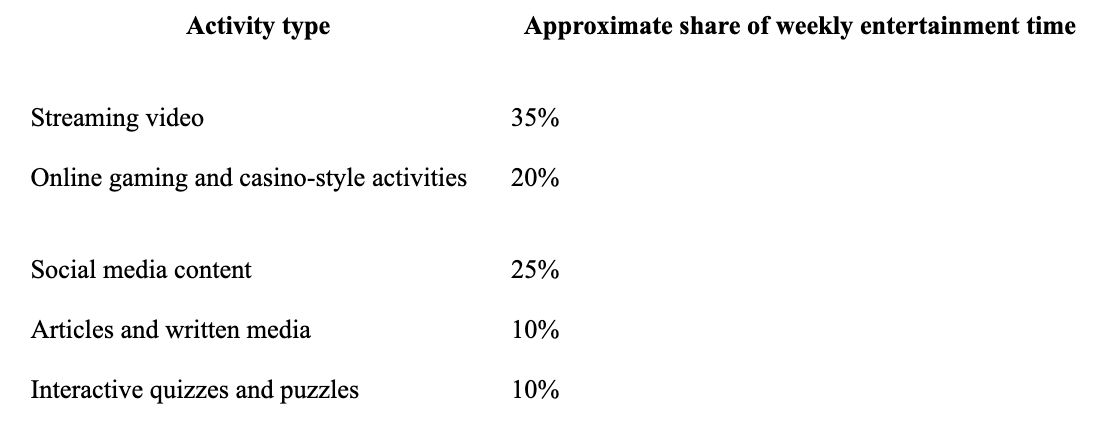
These numbers vary by age group and region, yet they illustrate the broad distribution of digital activity.
People rarely focus on a single format. Instead, they move between several forms of entertainment during the week.
Community interaction and discussion
Entertainment often becomes more engaging when users can interact with others. Canadians frequently participate in comment sections, forums, or live chats connected to digital content.
Community interaction creates several benefits:
- Users share opinions about shows, games, or articles
- New participants ask questions and receive quick answers
- Fans exchange tips or strategies related to games
These interactions increase time spent on a platform. People return not only for the content but also for the discussion that follows.
Transparent design without excessive advertising
Advertising funds many online platforms, yet Canadian users often react negatively to aggressive ad placement. Large pop-ups, auto-playing videos, or repeated interruptions reduce trust.
People generally prefer modest advertising that does not interrupt reading or viewing.
Sites that maintain balanced design often follow several principles:
- Limit full-screen pop-ups
- Avoid automatic audio playback
- Place advertisements clearly outside main content areas
When advertising interferes with navigation, users usually leave the page within seconds.
The role of research and informed choices
Canadian internet users increasingly rely on research before they choose new entertainment platforms. Search engines, online forums, and review discussions help them evaluate options.
People often compare several aspects:
- Rules and policies
- User feedback and discussion threads
- Technical performance reports
- Safety and data protection practices
This research behavior reflects a cautious approach to digital environments. Users rarely rely on advertising claims alone.
Modern online entertainment in Canada reflects a mix of convenience, careful evaluation, and varied interests. Users expect fast performance, clear design, and strong respect for privacy. They also look for content that matches their daily habits and cultural interests.
Short videos, quick games, and interactive features attract attention during busy hours. Longer articles and detailed discussions appeal to readers who want deeper information later in the day.
Transparency remains one of the most important expectations. Canadians often examine rules, privacy policies, and community guidelines before they spend time on a platform. When entertainment services communicate openly and maintain fair practices, they build lasting relationships with users.
As digital technology continues to evolve, these expectations will likely remain stable. Canadians will continue to value clarity, efficiency, and honest communication in the online spaces where they spend their leisure time.